
Introduction: a universal secret
When we talk about "conscious breathing," the reflex is to think of yoga. But the truth is deeper and more universal: every major spiritual tradition in humanity independently discovered that breath is the doorway to the sacred. From the caves of Siberian shamans to the monasteries of Mount Athos, from Sufi mosques to Zen temples, the same observation has been repeated for millennia: control the breath, control the mind; control the mind, touch the divine.
This is no coincidence. In almost every ancient language, the same word designates "breath," "spirit," and "soul": ruach in Hebrew, pneuma in Greek, spiritus in Latin, ruh in Arabic, atman in Sanskrit, qi in Chinese. Breathing isn't a side aspect of spirituality — it's the foundation.
Christianity: hesychasm and the prayer of the heart
The hesychast tradition
Hesychasm (from Greek hesychia, "inner silence") is the mystical tradition of Orthodox Christianity, practiced since the 4th century in Egyptian desert monasteries, then defended and theorized in the 14th century at Mount Athos by Gregory Palamas.
The central practice is the Jesus Prayer: "Lord Jesus Christ, Son of God, have mercy on me, a sinner." This short prayer is repeated continuously — but not as a mere mental mantra. Hesychast monks explicitly linked it to breathing:
- Inhalation: "Lord Jesus Christ, Son of God…"
- Exhalation: "…have mercy on me, a sinner."
Breathing must be slow, deep, diaphragmatic. Attention is directed toward the heart (not the anatomical heart, but the "spiritual center" located in the middle of the chest). Monks describe a descent of the mind into the heart — an experience of inner silence, presence, and union with God.
Saint Gregory of Sinai (14th century) wrote: "Sit on a low seat, lower your intellect from your head into your heart, and there, hold it. Bow painfully, and you will feel pain in your chest, shoulders, and neck. Cry out to the Lord Jesus, unceasingly." The instructions are remarkably similar to diaphragmatic meditation.
The Desert Fathers
As early as the 4th century, Christian hermits in Egypt (the "Desert Fathers") practiced a form of continuous prayer linked to breath. John Cassian reports that desert monks continually repeated a verse from the Psalms ("O God, come to my assistance; O Lord, make haste to help me") to reach the "unceasing prayer" called for by Saint Paul (1 Thessalonians 5:17). In the 7th century, John Climacus made the link explicit: "Let the remembrance of Jesus be present with your every breath."
Islam: dhikr and Sufi breathing
Dhikr: the remembrance of God
Sufism (the mystical dimension of Islam) places breathing at the heart of its practice. Dhikr ("remembrance," "recollection") involves repeating God's names or sacred formulas, systematically linked to breathing rhythm:
- Heart dhikr: silent inhalation with "Allah," exhalation with "Hu" (Him, the Divine Essence). The practitioner visualizes the divine name descending into the heart.
- Negation-affirmation dhikr: inhalation with "La ilaha" (there is no god), exhalation with "illa'llah" (except God). Head movement accompanies breathing — to the left then right, creating a "sweeping" motion.
Sufi breathing techniques
Sufi orders (tariqas) developed sophisticated breathing techniques:
- Habs-i dam (breath retention): similar to yogic kumbhakas, retention is used to concentrate spiritual energy in the heart.
- Pas-i anfas (breath watching): maintaining continuous awareness of each breath, associating each inhalation and exhalation with divine presence. Similar to Buddhist anapanasati. See our complete pranayama guide.
- Whirling dervish dance (Mevlevi): rotation is synchronized with specific breathing that induces a state of meditative trance — hands and arms create an energy circuit between heaven and earth.
Among the principles of the Naqshbandi path (named after the master Baha al-Din Naqshband, 14th century) is hosh dar dam, "awareness in the breath": letting no breath pass in inattention. The Naqshbandis practice silent dhikr (khafi), entirely linked to breathing — making it practicable in any situation.
Buddhism: anapanasati and zazen
Anapanasati: meditation on the breath
The Buddha taught anapanasati ("attention to breath") as the fundamental meditation practice. The Anapanasati Sutta describes 16 stages of breath contemplation, from simple observation to complete enlightenment.
The practice is radically simple: observe the breath as it is, without modifying it. Attention is placed at the nostrils or abdomen. When the mind wanders, gently bring it back to the breath. That's it. The Buddha declared that this single practice, perfected, could lead to complete awakening.
Zen: shikantaza and kinhin
Japanese Zen (derived from Chinese Chan) gives crucial importance to breathing:
- Zazen: seated meditation. Breathing is abdominal, slow, exhalation longer than inhalation. Attention placed in the hara (belly center, 3 cm below the navel). No visualization, no mantra — just breath and posture.
- Breath counting (susokukan): counting exhales from 1 to 10, then starting over. A seemingly simple exercise that reveals the mind's constant agitation.
- Kinhin: walking meditation. Each step synchronized with a breath — half a step per breath, incredibly slow. Same logic as the mountaineer's "rest step," but in a meditative context.
Master Dogen (13th century, founder of Soto Zen), in his instructions for zazen, stresses above all a correct posture and a calm breath passing gently through the nose, never forced.
Shamanism: breath as the vehicle for journeying
In shamanic traditions worldwide — Siberia, Amazon, Africa, Australia — breathing is the vehicle for shamanic journeying:
- Ritual hyperventilation: combined with rhythmic drumming (often around 4 beats per second, a rhythm some researchers link to theta waves, without consensus), it induces a trance state in which the shaman "travels" to the spirit world.
- Song and breath: the icaros (sacred songs) of Amazonian shamans are intrinsically linked to breath — each phrase is a controlled exhale, the silence between phrases is a retention charged with intention.
- Sweat lodges: breathing in a hot, smoky atmosphere naturally alters consciousness through hyperthermia and gas exchange modification.
Shamanism may be the oldest "breathwork" tradition — its roots probably go back well before yoga, Buddhism, and monotheistic religions.
Judaism: neshama and Kabbalah
In Hebrew, the word for "soul" (neshama) comes from the root nashama, "to breathe." The first thing God does after creating Adam is to "breathe into his nostrils a breath of life" (Genesis 2:7). Divine breath and human breath are intimately linked.
In the Kabbalistic tradition:
- Some Kabbalistic meditations associate the letters of the Tetragrammaton (YHVH) with phases of the breath — the correspondences vary between schools.
- Abraham Abulafia (13th century) developed meditation techniques combining breathing, head movements, and pronunciation of divine names — techniques remarkably close to pranayama.
Taoism: qi and embryonic breathing
Taoism considers breath as the vehicle for qi (vital energy):
- Embryonic breathing (tai xi): the ultimate goal is to recover the breathing of the fetus in the womb — a breath so subtle, so soft it's almost imperceptible. It's the exact opposite of shamanic hyperventilation, but the goal is the same: accessing a non-ordinary state of consciousness.
- Qigong: Qigong exercises synchronize movement, breath, and intention to circulate qi through meridians. Breathing is the "guide" for qi — where attention goes, breath follows; where breath goes, qi follows.
Lao Tzu (Tao Te Ching, chapter 10): "Can you, concentrating your breath, reach the suppleness of a newborn?"
The universal convergence
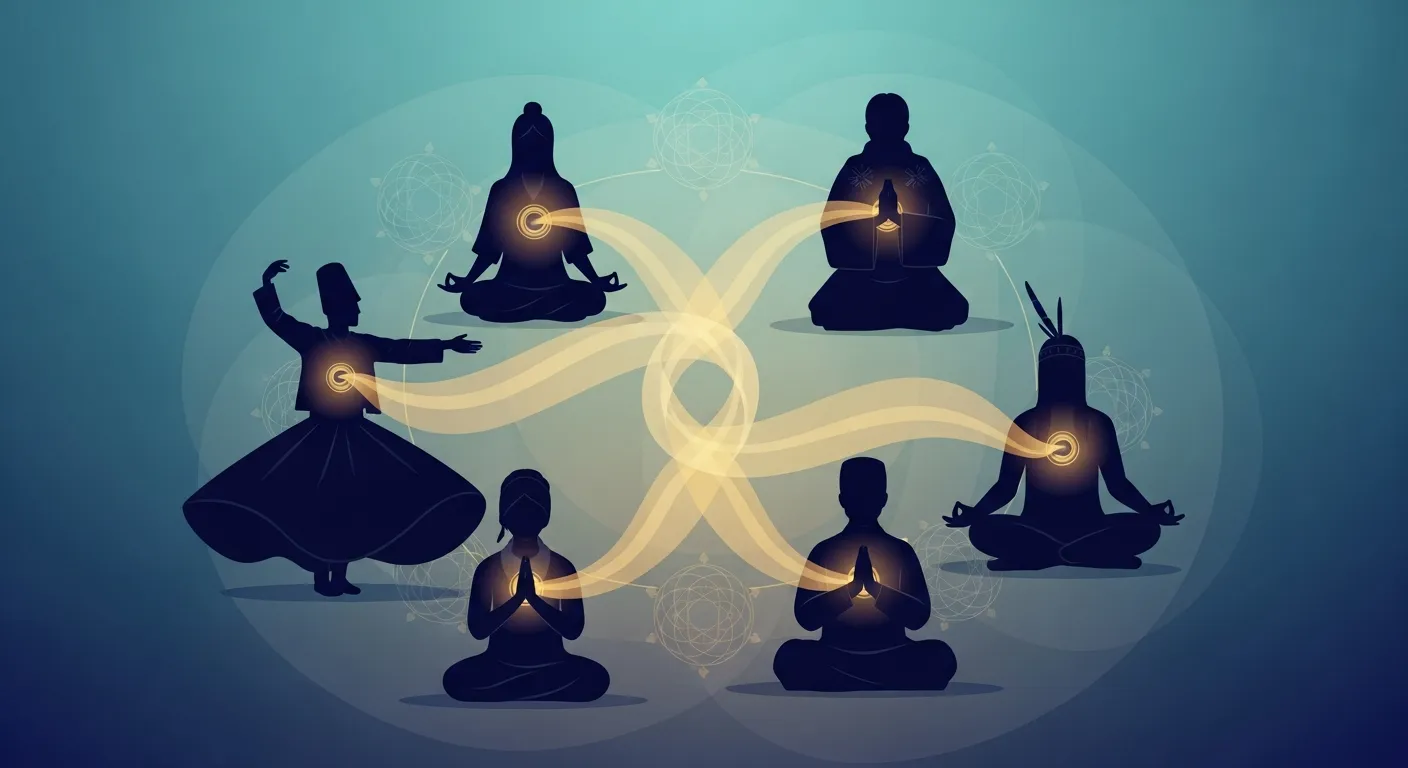
Despite thousands of miles and thousands of years of separation, all these traditions converge on the same principles:
- Breath is the bridge between body and mind — the only function that is both automatic and voluntary.
- Slowing the breath slows the mind — the universal basis of all meditation.
- Breath carries prayer — associating a sacred intention with breathing rhythm transforms a biological act into a spiritual one.
- Breath connects to the whole — inhalation as receiving, exhalation as giving. The oxygen you breathe now was exhaled by a tree, which received it from the sun. To breathe is to participate in the cycle of life.
Conclusion
Next time you take a conscious breath, know that you're practicing humanity's oldest ritual. Before temples, before sacred books, before even language, our ancestors understood that breath is the doorway between the visible world and the invisible. Whether you call it prana, ruach, pneuma, qi, or simply "air," it's the same force that flows through all traditions and all peoples. Breathing knows no religion, no border, no era — it's universal, like the sacred it carries.