
Key takeaways
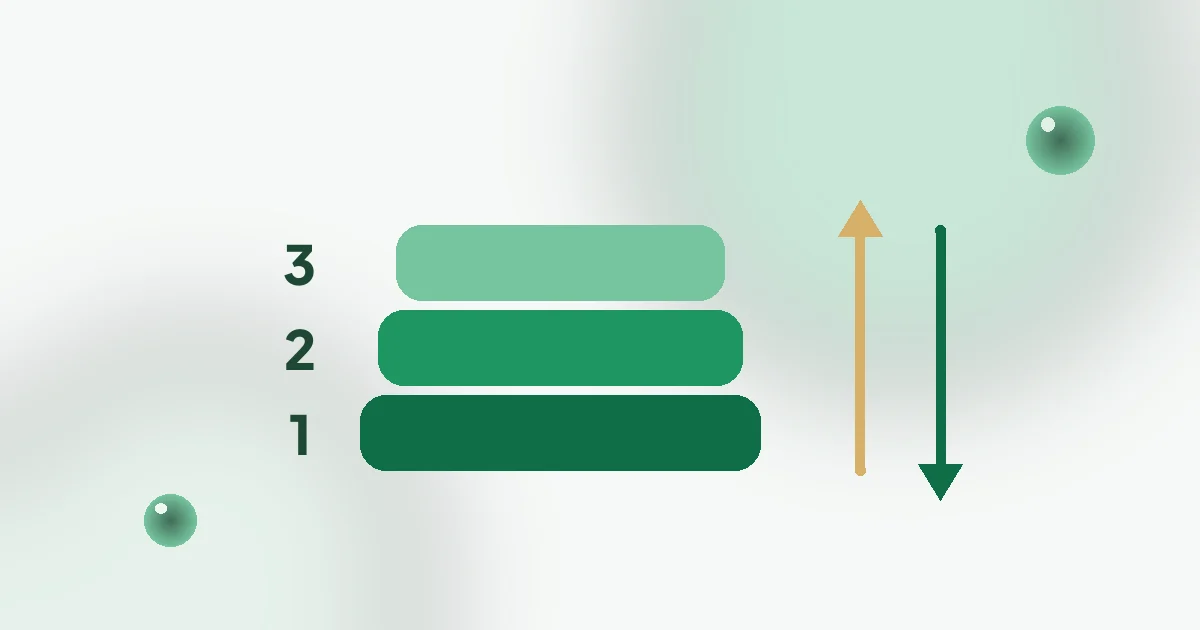
Ladder breathing, also known as pyramid breathing, is a progressive breathing exercise: your inhale and exhale always match, and both get one second longer on each "step" until you reach the top, then shorten again on the way down. A typical ladder runs 4, 5, 6, 7, 6, 5 and 4 seconds per breath. The point is to build breath control: you learn to lengthen your breath without straining and gently train your tolerance to CO₂, inside a structure that is easy to follow.
- 7 steps per ladder: base, +1, +2, +3 (the top), +2, +1, base. On every step, the exhale is as long as the inhale.
- 74 seconds for one ladder with a 4-second base (4-5-6-7-6-5-4), an average of about 5.7 breaths per minute.
- A full-lung hold at the top at higher levels: 4, 10 or 16 seconds.
- 2 ladders in 3 minutes at the entry levels; at advanced levels, where one ladder takes 92 to 132 seconds, the exercise fits 5- or 10-minute sessions better.
- A progressive effort: best in the morning or during the day, not at bedtime.
What is ladder breathing?
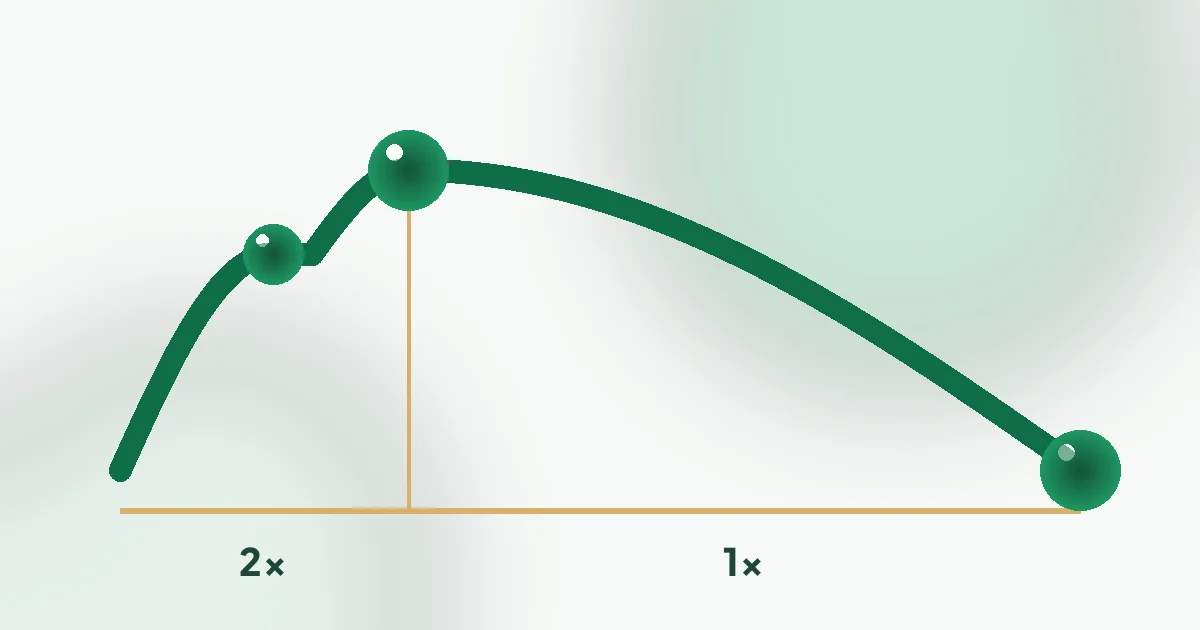
Picture climbing a staircase with your breath. On the first step, you breathe in for 4 seconds and out for 4 seconds. On the second, 5 and 5. Then 6 and 6, then 7 and 7: that is the top. You come back down through 6, 5 and 4. Plot those durations and you get a pyramid, which is why the same pattern is sold as the pyramid breathing technique.
Ladder breathing has no single inventor or founding text. It is a training structure that shows up in yoga classes, breathwork programs and athletic conditioning under different names. It borrows the logic of the step-by-step tables freedivers use, where difficulty rises in stages, but it is far gentler: for most of the exercise you are not holding your breath at all, just slowing it down.
How it differs from other techniques
Most breathing exercises keep one fixed pace from start to finish. Box breathing repeats 4-4-4-4 with two holds per cycle; resonance or coherent breathing repeats 5-5 with no hold. The ladder breathing technique changes pace with every breath. That has two effects. First, your attention stays engaged, because you have to know which step you are on. Second, the difficulty is dosed: the top only arrives after three warm-up steps, and the descent lets your body settle back down.
It is also different from the three-part breath (dirga pranayama), which is about where you breathe (belly, ribs, upper chest) rather than how long. The two pair well: the longer the step, the more natural it feels to fill all three parts.
How to do the ladder breathing exercise, step by step
- Sit down with a tall but relaxed spine, feet flat. Rest one hand on your belly if you want to feel the breath drop low.
- Take three or four normal breaths, then start step one: inhale through your nose for 4 seconds, exhale through your nose for 4 seconds.
- Add one second per step: 5 and 5, 6 and 6, then 7 and 7 at the top. Count in your head or follow a guided voice.
- At the top, if your level includes it, hold with full lungs for a few seconds, throat soft, shoulders down.
- Climb back down: 6 and 6, 5 and 5, 4 and 4. That is one ladder. Start the next one or return to easy breathing.
One ladder with a 4-second base takes just over a minute. Keep breathing through your nose: it naturally slows the airflow, which is exactly what you need on the long steps.
Common mistakes
- Taking in more air instead of slowing down. A longer step does not mean a bigger breath. Keep roughly the same volume and let it flow in more slowly. That is the whole skill of lengthening the breath without forcing it.
- Stopping at the end of the inhale. Apart from the planned hold at the top, the air should keep moving, like a thin, steady stream.
- Rushing the way down. The descending steps matter as much as the climb; that is where your body settles.
- Gritting your teeth through the top. If the urge to breathe gets strong, drop back to your base step. It should stay comfortable.
Pyramid breathing rhythms for every level
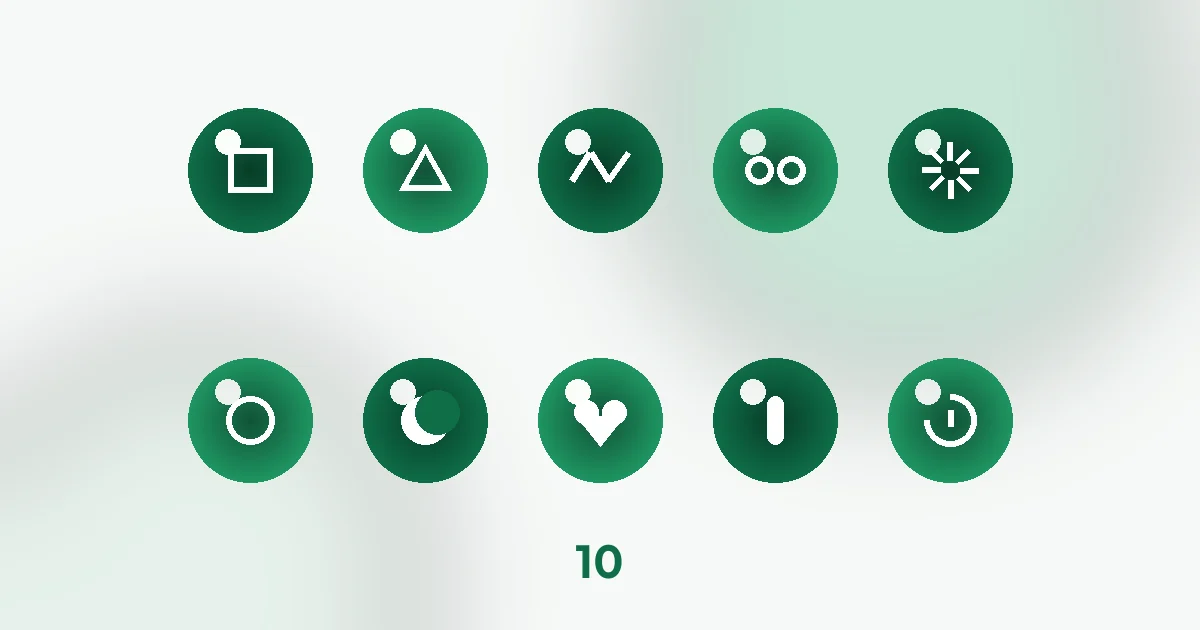
How high your ladder goes depends on your CO₂ tolerance. BreathLife sets the base step and the top hold across five levels. The length of one ladder is simple math: twice the sum of the steps, plus the hold if there is one.
| Level | Steps (inhale = exhale, in s) | Hold at the top | One ladder | Ladders in 3 min | In 5 / 10 min |
|---|---|---|---|---|---|
| Tight | 4-5-6-7-6-5-4 | — | 74 s | 2 | 3 / 7 |
| Short | 4-5-6-7-6-5-4 | — | 74 s | 2 | 3 / 7 |
| Optimal | 5-6-7-8-7-6-5 | 4 s | 92 s | — | 3 / 6 |
| Efficient | 5-6-7-8-7-6-5 | 10 s | 98 s | — | — / 5 |
| Exceptional | 7-8-9-10-9-8-7 | 16 s | 132 s | 1 | 2 / 4 |
The app only runs whole ladders: a session ends when the last complete ladder ends, so it can run a little shorter than the length you picked. Sessions keep about 20 seconds for the voice intro, and the app only schedules Ladder when whole ladders fill at least three quarters of the time. That is why it does not show up in 3-minute sessions at the Optimal and Efficient levels, or in 5-minute sessions at Efficient.
How to pick your level
Your level comes from the 60-second breathing age test. After a normal exhale, you hold your breath and time it until the first urge to breathe, without pushing through. That number reflects your CO₂ tolerance. As a rough guide for adults under 40: up to 12 s is Tight, up to 25 s is Short, up to 38 s is Optimal, up to 60 s is Efficient, and anything beyond is Exceptional. The cutoffs drop with age; between 50 and 69, for example, they become 10, 18, 35 and 50 s.
A practical rule: if you reach the top wanting to cut the step short, stay one level lower for a few days. If two ladders feel effortless, move up. To understand what drives that urge to breathe, read our guide to breath-hold training and CO₂ tolerance.
Benefits of ladder breathing: what the science says
To be upfront: as far as we know, no study has looked at ladder or pyramid breathing specifically. What is well documented are its ingredients: slow breathing, CO₂ regulation, and how your body decides it is time to breathe. The ladder simply puts them in sequence.
Slow breathing, one step at a time
At the entry level, a 4-second step works out to 7.5 breaths per minute and the 7-second top to about 4.3. The whole ladder stays under the 10-breaths-per-minute line that defines slow breathing in the systematic review by Zaccaro and colleagues (2018). Across 15 studies in healthy adults, they linked that pace to higher heart rate variability (HRV), more alpha activity on EEG, and lower anxiety scores, with participants also reporting more vigor and alertness.
Russo, Santarelli and O'Rourke (2017) lay out the mechanics: at a slow pace, ventilation gets more efficient because a larger share of each breath reaches the alveoli; respiratory sinus arrhythmia grows; and the baroreflex, which steadies blood pressure, becomes more sensitive. Drawing on earlier work, their review also describes a blunted chemoreflex, the system that reacts to low oxygen and high CO₂.
Lehrer and Gevirtz (2014), writing about HRV biofeedback, explain that these effects peak around a resonance frequency close to 6 breaths per minute, which varies from person to person. A ladder with a 4-second base passes through that range on every climb and every descent. That is not the same as measuring your own resonance frequency, but it helps explain why the exercise feels calming even though it is a form of training.
CO₂ tolerance, trained in stages
The urge to breathe is driven mostly by rising carbon dioxide (CO₂), not by a lack of oxygen. In his review of the breath-hold breaking point, Parkes (2006) notes that this moment depends on several factors, including CO₂, oxygen and lung volume, and that it is not fixed. The long steps and the hold at the top let CO₂ rise slightly; the descent lets it fall back. It is gentle, repeated exposure, nowhere near a maximal breath hold.
A few minutes a day can be enough
Balban and colleagues (2023) compared three breathing exercises with mindfulness meditation, 5 minutes a day for a month. The breathing exercises improved mood more than meditation did. Ladder breathing was not one of the protocols tested; the takeaway is that short, regular practice of a structured breathing pattern produced measurable effects. Studies suggest these benefits; none of them guarantees a result for any one person.
When to use pyramid breathing, and when to skip it
Good moments
- In the morning, to start the day with a full breath and a clear head.
- Around a workout: as a breathing warm-up, or to bring your pace back down afterward. Our article on breathing for sports performance covers how to fit it in.
- Midday, when the slump hits and you want something with more lift than coherent breathing.
- To level up after a few weeks of fixed-pace exercises, when you want a breathing drill that asks a bit more.
When something else works better
Pyramid breathing is a progressive effort, not a wind-down. In the app, it is never suggested in the evening. For sleep, an extended exhale or 4-7-8 breathing is a better fit. If anxiety is spiking, skip the long steps and the hold too; a slow exhale is all you need.
Safety
Never force it. If the urge to breathe gets strong, drop back to your base step or return to normal breathing. BreathLife is not a medical device. This exercise is not recommended during pregnancy or with a heart or respiratory condition unless your doctor approves it; check with them too if you have epilepsy. Never practice breath holds in water or while driving. If you feel dizzy, stop and breathe normally.
Ladder breathing vs. similar techniques
| Technique | Rhythm | Main effect | Best time |
|---|---|---|---|
| Ladder (pyramid) breathing | 4-5-6-7-6-5-4, inhale = exhale | Breath control, gradual CO₂ tolerance | Morning, daytime, around exercise |
| Box breathing | 4-4-4-4, two holds | Calm under pressure | Before a stressful situation |
| Breath-hold training | Timed empty-lung holds | Targeted CO₂ tolerance | Experienced practitioners, away from meals |
| Three-part breath | Belly, ribs, chest | Breath depth and awareness | Any time, as a warm-up |
To see these side by side with the rest, read our complete guide to breathing exercises.
How BreathLife guides ladder breathing
In the BreathLife breathing exercises app, pyramid breathing is called "Ladder," added in late October 2026. The steps and the hold at the top are set to your level from the breathing age test, and a guided voice in English or French calls out every step so you never have to count. Pick 3, 5 or 10 minutes (3 by default) and the app runs whole ladders. Ladder is part of the Sport and Energy programs, 28-day plans tuned to your level; the first session is free, no credit card required.
Conclusion
Ladder breathing turns a breathing exercise into a clear progression: one second longer per step, a moment at the top, then back down. It teaches you to lengthen your breath by slowing it rather than inflating it, and it gets your body used to a little more CO₂ without strain. No study has tested it directly yet, but it rests on well-described mechanisms. To find out which step to start on, take the free breathing age test.