
Key takeaways
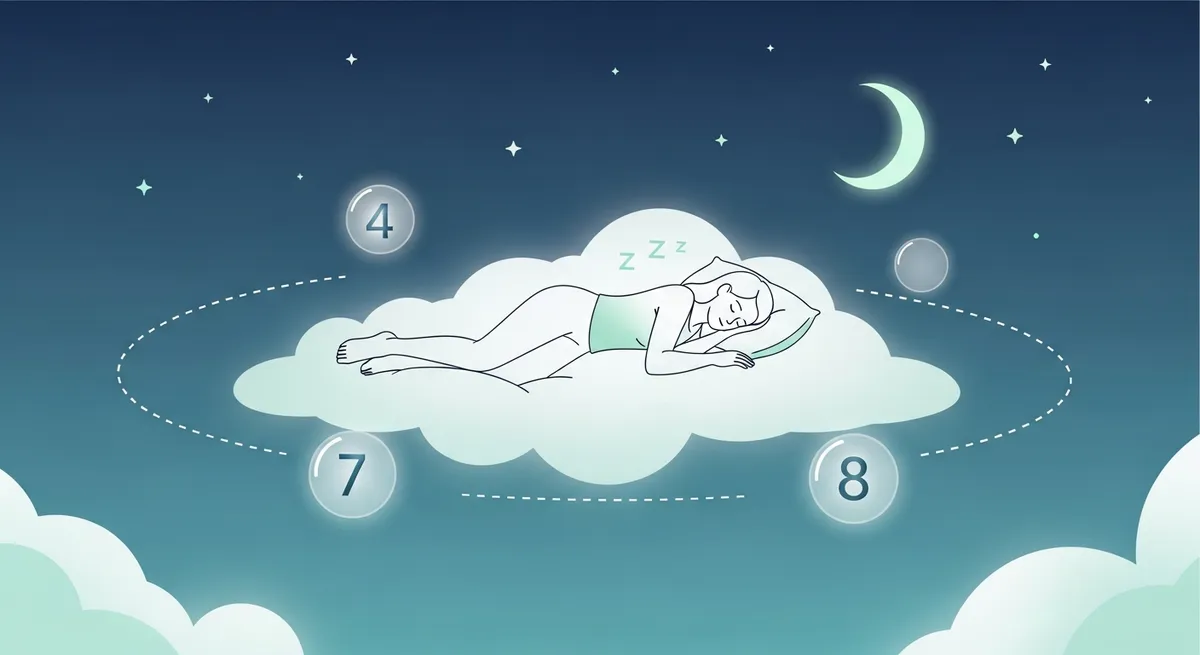
The 4-7-8 breathing technique is Dr. Andrew Weil's method for falling asleep, adapted from yogic pranayama: inhale through your nose for 4 seconds, hold for 7, exhale through your mouth for 8, tongue resting behind your upper front teeth. The slow pace and long exhale help many people release bedtime tension.
- 19 seconds per cycle, roughly 3 breaths per minute.
- Start with 4 cycles, then build up to 10 (just over 3 minutes).
- The ratio matters more than the count: start at 3-5-6 if needed. BreathLife scales it from 3-5-6 to 7-10-11 by level.
- Limited research: it lowered heart rate right after a session (Vierra et al., 2022); its effect on falling asleep hasn't been measured.
Introduction: the natural tranquilizer of the nervous system
It's 11:30 PM. You've been in bed for an hour. Your eyes are closed but your mind is wide open. It's replaying the day, anticipating tomorrow, worrying about things you can't control. About one adult in three reports this kind of sleep trouble (Roth, 2007).
The 4-7-8 breathing technique, developed by Dr. Andrew Weil of the University of Arizona, is often described as the "natural tranquilizer of the nervous system." That is an image, not a comparison with a drug: no study has measured it against anti-anxiety medication. But its long exhale and steady counting help many people let go of bedtime tension.
In this guide, you'll discover exactly how this technique works, why it's so effective, and how to integrate it into your evening routine to transform the quality of your nights.
The origin of the 4-7-8 technique
Dr. Andrew Weil, a Harvard-trained physician and pioneer of integrative medicine, developed the 4-7-8 technique drawing inspiration from pranayama, the ancient yogic art of breath regulation. It is not a specific traditional technique: it is a modern, simplified adaptation that borrows the breath hold and the lengthened exhale from pranayama.
Dr. Weil has presented it for many years, to his patients as well as in his talks and videos, as a simple tool to calm down and prepare for sleep.
What distinguishes 4-7-8 from other breathing techniques is the extended breath hold followed by an exhale twice as long as the inhale. One cycle lasts 19 seconds: your breathing drops to about 3 cycles per minute, and the long exhale supports vagus nerve activity, the main regulator of the parasympathetic nervous system. Holding your breath does not make you "absorb more oxygen": in a healthy person, blood is already almost fully saturated with oxygen at rest.
The 4-7-8 protocol step by step
Here is the exact protocol, as recommended by Dr. Weil:
Preparation
- Lie down in bed or sit comfortably.
- Place the tip of your tongue against the roof of your mouth, just behind your upper front teeth. It will stay in this position throughout the exercise.
- Exhale completely through your mouth, making a whooshing sound.
The 4-7-8 cycle
- Inhale through your nose for 4 seconds, silently, expanding your belly.
- Hold your breath for 7 seconds, without straining. If 7 seconds feels long, hold only as long as it stays comfortable.
- Exhale through your mouth for 8 seconds, making an audible whooshing sound. The exhale is deliberately audible to maintain rhythm.
How many cycles?
- If you are new to it: start with 4 cycles, approximately 1 minute and 16 seconds. This is enough to feel a first sense of calm.
- Then: build up gradually to 10 cycles (just over 3 minutes), the number we follow in our guided video session.
- In every case: stop and return to natural breathing if you feel dizzy or tingly, or if the hold becomes uncomfortable.
Essential point
The 4:7:8 ratio matters more than absolute duration. If 4-7-8 seconds seems too long at first, you can start with 2-3.5-4 seconds (maintaining the same ratio) and gradually increase.
The science behind the effectiveness
The 4-7-8 technique isn't a folk remedy: its effects rest on known physiological mechanisms.
1. Parasympathetic nervous system activation
The extended exhale (8 seconds) stimulates the vagus nerve, which activates the body's "rest and digest" response. This translates to lower heart rate, decreased blood pressure, and muscle relaxation. It's the direct antidote to the hypervigilance state that prevents sleep.
2. Increased blood CO₂
The 7-second hold allows CO₂ to slightly accumulate in the blood. In principle, slightly higher CO₂ helps hemoglobin release the oxygen it carries (the Bohr effect). Over a 7-second hold, however, this effect stays modest: the calming comes mostly from the slow rhythm and the long exhale.
3. Cognitive distraction
Counting 4-7-8 occupies your conscious mind enough to interrupt the flow of anxious thoughts, without being stimulating enough to keep you awake. It's a light but effective "attentional anchor" that replaces rumination with sensory focus.
4. Circadian rhythm regulation
Practiced regularly at the same time, the 4-7-8 technique creates a Pavlovian signal for your brain: "when I do this exercise, it's time to sleep." After a few weeks, this ritual can help your body get ready for sleep from the first cycles.
What studies say
4-7-8 itself has been studied very little, and the available evidence is modest:
- In 43 healthy young adults, three sets of six 4-7-8 cycles lowered heart rate and systolic blood pressure and increased heart rate variability right after the session (Vierra et al., Physiological Reports, 2022).
- In a comparison of 84 college students, breathing at 6 cycles per minute increased heart rate variability more than 4-7-8 or box breathing; none of the techniques meaningfully changed mood or blood pressure in a single session (Marchant et al., Applied Psychophysiology and Biofeedback, 2025).
- More broadly, a meta-analysis of 12 randomized trials (785 adults) links breathing exercises to a small-to-moderate reduction in perceived stress, with similar effects on anxiety and depressive symptoms (Fincham et al., Scientific Reports, 2023).
No study has yet measured the specific effect of 4-7-8 on the time it takes to fall asleep. The best approach is to judge it for yourself over two to three weeks of regular practice.
Integrating 4-7-8 into your evening routine
To maximize the technique's effectiveness, here's an optimal evening routine:
60 minutes before bedtime
- Dim the lights in your home.
- Turn off screens (or activate a blue light filter).
- Avoid heavy meals, alcohol, and caffeine for at least 4 hours.
30 minutes before bedtime
- Take a lukewarm shower (the subsequent drop in body temperature promotes sleepiness).
- Prepare your bedroom: 64-66°F (18-19°C), complete darkness, silence or white noise.
In bed
- Lie down in a comfortable position.
- Close your eyes and do a quick body scan: consciously release your jaw, shoulders, hands.
- Perform your 4 to 10 cycles of 4-7-8.
- If you're still awake after the cycles, stay lying down without opening your eyes and let the relaxation spread, without checking the time.
Mistakes that reduce effectiveness
- Inhaling too hard: the inhalation should be calm and nasal, not a big gulp of air. Think "fill" not "suck."
- Forgetting tongue placement: this detail seems minor but it stabilizes the jaw and creates an energy circuit according to yogic tradition.
- Expecting immediate results: Dr. Weil insists on one point: the technique takes full effect after 4 to 6 weeks of twice-daily practice. The first few days, you'll feel relaxation; any effect on falling asleep takes longer to develop.
- Holding breath to discomfort: the 7 seconds should be manageable without effort. If it's difficult, reduce the ratio (e.g., 3-5-6) and gradually increase.
- Only practicing at bedtime: Dr. Weil also recommends 4 cycles in the morning and 4 during the day. This trains your nervous system for controlled relaxation, making the evening session even more effective.
Beyond sleep: other uses
The 4-7-8 technique isn't just for bedtime. Here are other moments when it's particularly useful:
- Anxiety attacks: 4 cycles are often enough to interrupt an anxiety spiral.
- Before stressful events: exams, public speaking, job interviews.
- Food cravings: the technique helps short-circuit impulsive cravings (Dr. Weil specifically recommends it for this).
- Anger: 4 cycles before responding to an irritating situation allow you to respond rather than react.
4-7-8 vs other breathing techniques
How does 4-7-8 compare to other methods?
- Cardiac coherence (5-5): better suited for daytime use, seated. Ideal for chronic stress management. 4-7-8, with its hold and long exhale, is designed more for bedtime.
- Box breathing (4-4-4-4): used by Navy SEALs for calm under pressure. More stimulating than 4-7-8, less suited for sleep.
- Wim Hof: controlled hyperventilation technique for energy and immunity. Opposite effect to 4-7-8 — never practice before sleeping.
Conclusion
The 4-7-8 technique is one of the simplest ways to calm down before sleep, without medication. Its 4-step protocol (prepare, inhale, hold, exhale) can be learned in 30 seconds and practiced anywhere. The key to success: consistency. Practice it twice daily for a few weeks to make it a reflex. If insomnia sets in, talk to a doctor.
To complete your recovery routine, also explore the breathing power nap technique — ideal for recharging in 15 minutes during the day.