
Key takeaways
Breathing exercises for sleep help your nervous system shift from "alert" mode into the "rest" mode you need to drift off. They share a slow pace and an exhale longer than the inhale. In a small study, 20 minutes of slow breathing before bed helped people with insomnia fall asleep faster (Tsai et al., 2015).
- 5 techniques: 4-7-8, the physiological sigh, night-mode cardiac coherence, a breathing body scan, alternate nostril breathing.
- Easiest start: in bed, inhale for 4 seconds, exhale for 6, for 5 minutes.
- Wind-down routine: screens off 30 minutes before bed, then 4-6 breathing under the covers.
- Give each technique a week; if insomnia persists, talk to a doctor.
Introduction: why breathing is the key to sleep
You know the scenario: you're exhausted, you get into bed, and yet your mind refuses to shut off. Thoughts loop endlessly, your body stays tense, and sleep won't come. Counting sheep doesn't work — but counting your breaths does.
Research often describes insomnia as a state of sympathetic nervous system hyperactivation. Your body is stuck in "alert" mode, with a heart rate that's too high, inappropriate cortisol levels, and breathing that's too fast. To sleep, you need to switch to the parasympathetic nervous system — "rest and recovery" mode.
Breathing is one of the most accessible levers to make this switch: in a small study, 20 minutes of slow breathing before bed shortened the time to fall asleep and reduced awakenings in people with insomnia (Tsai et al., 2015). Here are 5 techniques, ranked from simplest to most advanced, with precise protocols you can apply tonight.
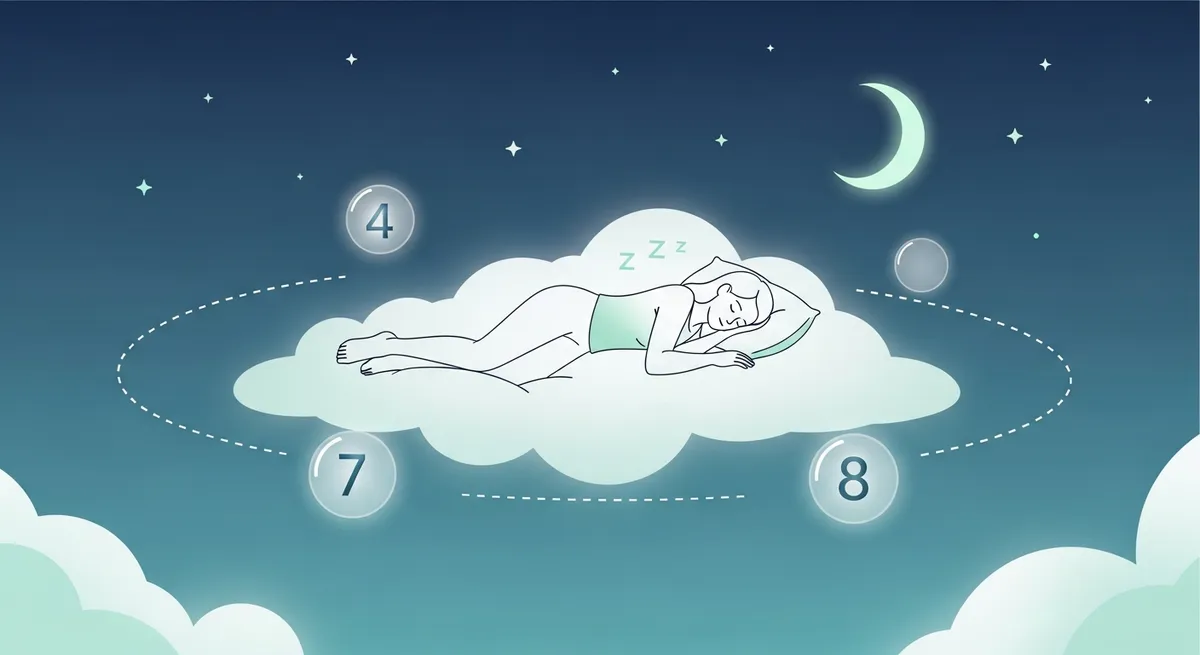
Technique 1: Dr. Andrew Weil's 4-7-8 breathing
This is the best-known technique for falling asleep, even though its specific effect on sleep onset has not yet been measured. Dr. Andrew Weil, professor at the University of Arizona, describes it as a "natural tranquilizer for the nervous system."
Protocol:
- Place the tip of your tongue against the roof of your mouth, just behind your upper front teeth. It stays there throughout the exercise.
- Exhale completely through your mouth making a "whoosh" sound.
- Close your mouth. Inhale silently through your nose counting to 4.
- Hold your breath counting to 7.
- Exhale completely through your mouth ("whoosh" sound) counting to 8.
- Repeat the cycle 4 times total.
Why it works: the very slow rhythm and the long 8-second exhale favor vagus nerve activity. In young adults, a few rounds of 4-7-8 lowered heart rate and systolic pressure and raised heart rate variability right after the session (Vierra et al., 2022).
Technique 2: the physiological sigh
Popularized by neuroscientist Andrew Huberman at Stanford University, this technique deliberately reproduces the sighs your body makes spontaneously every few minutes to reinflate the lung's air sacs (Li et al., 2016).
Protocol:
- Inhale through your nose in two parts: a first breath that fills your lungs three-quarters, immediately followed by a shorter second breath that fills them completely.
- Exhale slowly and fully through your mouth.
- Repeat 5-10 times.
Why it works: the double inhale reopens collapsed air sacs in the lungs. The long exhale that follows has a calming effect. In a Stanford study (2023), 5 daily minutes of cyclic sighing for one month improved mood more than mindfulness meditation (Balban et al., 2023).
Technique 3: "night mode" cardiac coherence
Classic cardiac coherence (5-5: 5 seconds in, 5 seconds out) is effective for daytime stress management. For sleep, a modified version with an extended exhale is often more soothing.
Protocol:
- Lie in bed, lights off.
- Inhale through your nose for 4 seconds.
- Exhale through your nose (or mouth) for 6 seconds.
- Maintain this rhythm for 5 minutes (30 cycles).
Why it works: the 4:6 ratio (shorter inhale than exhale) favors the vagus nerve during the exhale phase: at a slow pace, a longer exhale raises the vagal component of heart rate variability and the feeling of relaxation (Van Diest et al., 2014). This is the ideal technique for those who find 4-7-8 too demanding.
Technique 4: the breathing body scan
This technique combines diaphragmatic breathing with progressive body awareness, creating a dual deactivation: physiological (through breathing) and cognitive (through attention focus).
Protocol:
- Lie down comfortably. Close your eyes.
- Inhale through your nose for 4 seconds, mentally directing your breath toward your feet. Imagine them relaxing and becoming heavy.
- Exhale for 6 seconds, releasing all tension in your feet.
- Next inhale: direct the breath toward your calves and knees.
- Continue upward progressively: thighs, pelvis, belly, chest, hands, arms, shoulders, neck, face, scalp.
- Each area receives 2-3 breaths before moving to the next.
Why it works: the mind cannot simultaneously worry about tomorrow and focus on the sensation in the left foot. The breathing body scan occupies conscious attention with a monotonous yet sufficiently engaging task to prevent rumination. It's common to fall asleep before reaching the head.
Technique 5: alternate nostril breathing (Nadi Shodhana)
From the yoga tradition, this technique has been used for millennia to calm the mind and prepare the body for sleep. A few modern studies show an immediate calming effect (Telles et al., 2013).
Protocol:
- Sit comfortably or lie down.
- With your right thumb, close the right nostril.
- Inhale through the left nostril for 4 seconds.
- Close both nostrils (thumb on right, ring finger on left). Hold for 4 seconds.
- Open the right nostril. Exhale for 6 seconds.
- Inhale through the right nostril for 4 seconds.
- Close both nostrils. Hold for 4 seconds.
- Open the left nostril. Exhale for 6 seconds.
- That's one complete cycle. Repeat 10 cycles.
Why it works: the nostrils naturally alternate dominance over the day (nasal cycle). According to an Indian study, breathing through the left nostril tends to calm and through the right tends to activate (Telles et al., 1994); these effects are still debated. The slow rhythm and long exhales, for their part, favor parasympathetic activity.
Creating your pre-sleep routine
To maximize the effectiveness of these techniques, integrate them into a coherent routine:
- 30 minutes before bed: turn off screens. Their light in the evening can delay melatonin release.
- 15 minutes before: do 5 minutes of alternate breathing (seated) to calm the mind.
- In bed: follow with "night mode" cardiac coherence (4-6) for 5 minutes.
- If sleep doesn't come: switch to the breathing body scan or the 4-7-8 technique.
The key is consistency. Your body learns to associate these breathing patterns with the signal "it's time to sleep." With a few weeks of daily practice, this ritual often makes falling asleep easier.
Mistakes that sabotage your sleep
- Checking the time: every glance at the clock triggers micro-anxiety ("it's already 2 AM!"). Turn your alarm clock around and move your phone away.
- Trying too hard: sleep is about letting go. The harder you try to fall asleep, the more you activate the sympathetic system. Focus on the breathing, not on falling asleep.
- Switching techniques too quickly: give each technique at least a week before moving to the next. The brain needs time to create new associations.
- Ignoring sleep hygiene: breathing won't compensate for a room at 25°C (77°F), 3 coffees after 4 PM, or a screen in bed. Optimize the fundamentals first.
Conclusion
Insomnia isn't inevitable and sleeping pills aren't the only solution. Your breathing is a lever that helps your nervous system shift from "alert" to "rest" mode. The 5 techniques presented here are free, safe for most people, and accessible starting tonight. If insomnia lasts more than a few weeks, talk to a doctor. Begin with the simplest (4-6 cardiac coherence) and progress to more advanced techniques. The BreathLife app guides you by voice, with a Sleep path whose sessions happen in the evening, including Deep Sleep (4-7-8).
For short daytime recovery breaks, also discover the breathing power nap — an effective method to recharge in 15 minutes without disrupting night sleep.