
Key takeaways
Breathing age (or breath age) compares how efficiently you breathe with what is expected for your age group. You can estimate it at home with a CO₂ tolerance test: after a full exhale (all the air out), count the seconds until your first urge to breathe. Take the free breathing age test to find yours.
- Four factors: CO₂ tolerance, resting breathing rate, tidal volume, diaphragm use.
- A 60-second test: stop at the first urge to breathe, not at discomfort.
- 5 levels under age 40: Tight (up to 12 s), Short (up to 25 s), Optimal (up to 38 s), Efficient (under 60 s), Exceptional (60 s). Thresholds drop with age.
- It can improve with nasal breathing, cardiac coherence and longer exhales.
Introduction: your breathing has an age
You know your chronological age. Perhaps even your metabolic age or cardiac age. But do you know your breathing age, sometimes simply called your breath age? This concept, still largely unknown to the general public, reveals essential information about your overall health, stress levels, and ability to handle challenging everyday situations.
Breathing age is an indicator that measures the quality and efficiency of your breathing compared to what it should be for your age group. A 35-year-old can easily have the breathing age of a 55-year-old — and vice versa. The good news: unlike your chronological age, your breathing age can be significantly reduced through simple, accessible techniques.
What exactly is breathing age?
Breathing age is a composite measurement that takes several factors into account:
- CO₂ tolerance: your ability to withstand higher levels of carbon dioxide in your body without feeling discomfort. This is the simplest indicator to measure on your own.
- Resting breathing rate: a healthy adult breathes between 12 and 20 times per minute. A persistently high rate can signal chronic hyperventilation, often linked to stress.
- Tidal volume: the amount of air moved with each normal breath. Shallow breathing — limited to the upper chest — only mobilizes a fraction of lung capacity.
- Diaphragm usage: the main breathing muscle. Most stressed adults breathe using accessory muscles (shoulders, neck) rather than the diaphragm.
How BreathLife calculates it, with every threshold by age, the full grid and its limits: our breathing age method.
The core idea is simple: the more efficient your breathing, the lower your "breathing age." A breathing age below your chronological age is a sign of good respiratory health and a well-regulated nervous system.
Why does your breathing age matter?
Breathing is the only function of the autonomic nervous system that you can voluntarily control. It's a direct bridge between your conscious mind and your unconscious nervous system. Here's why it matters:
Impact on stress and anxiety
Poor breathing constantly activates the sympathetic nervous system — the "fight or flight" mode. The result: elevated cortisol, muscle tension, anxious thoughts. Slow, deep breathing helps calm this response: in an 8-week controlled trial, adults trained in slow belly breathing saw their salivary cortisol drop, unlike the control group (Ma et al., 2017).
Impact on sleep
People with a high breathing age tend to breathe through their mouth at night, causing micro-awakenings, dry throat, and poor sleep quality. Dr. Patrick McKeown, author of The Oxygen Advantage, emphasizes that nasal breathing during sleep increases nitric oxide production, a natural vasodilator that improves tissue oxygenation.
Impact on physical performance
Trained endurance athletes often have better CO₂ tolerance than average, allowing them to maintain intense effort longer without hyperventilating (see our guide on breathing and sports performance). But you don't need to be an elite athlete to benefit: even for climbing stairs or running to catch the bus, a better breathing age makes a difference.
Impact on long-term health
Large population studies point the same way: in the Framingham study, low vital capacity predicted more cardiovascular disease (Kannel et al., 1983), and in the Buffalo Health Study, followed for 29 years, low lung function was linked to higher mortality, even after accounting for smoking, blood pressure and weight (Schünemann et al., 2000). Taking care of your breathing means investing in your long-term health.
How to measure your breathing age
There are several methods, from the simplest to the most technical:
1. The CO₂ tolerance test (BOLT test)
This is the most accessible method for evaluating your breathing age at home. Here's the protocol:
- Sit comfortably and breathe normally for 2 minutes.
- After a normal exhale (not forced), pinch your nose.
- Time how long until your first urge to breathe — not until extreme discomfort.
- Resume normal breathing. If you need to take a big gasp, you waited too long.
Interpreting the results:
- Up to 12 seconds: very high breathing age, likely hyperventilation. "Tight" level.
- 13 to 25 seconds: below average. "Short" level.
- 26 to 38 seconds: within the norm. "Optimal" level.
- 39 to 59 seconds: good breathing capacity. "Efficient" level.
- 60 seconds (the test's maximum): excellent CO₂ tolerance. "Exceptional" level.
These benchmarks apply to adults under 40; they drop with age (for example 10, 18, 35 and 50 seconds between 50 and 69), and the test accounts for it.
2. The BreathLife app
The BreathLife app integrates this test in a guided manner and assigns you a precise breathing age based on your score: see how the breath age test works. It tracks your progress over time and offers exercises adapted to your level to progressively improve your tolerance.
3. Medical spirometry
For a complete clinical measurement, a pulmonologist can perform spirometry. This test measures your FEV1 (Forced Expiratory Volume in one second) and FVC (Forced Vital Capacity). Compared with norms for your sex, height and age, these results can be used to estimate a clinical "lung age."
Factors that degrade your breathing age
Several daily habits accelerate the "aging" of your breathing:
- Sedentary lifestyle: sitting all day compresses the diaphragm and promotes shallow breathing.
- Chronic stress: it programs the body for rapid, thoracic breathing, even in the absence of danger.
- Mouth breathing: breathing through the mouth — especially at night — reduces air filtration, causes water loss, and decreases nitric oxide production.
- Pollution: exposure to fine particles reduces the gas exchange capacity of pulmonary alveoli.
- Smoking: obviously the most degrading factor for breathing age, with measurable lung capacity loss after just a few months.
- Lack of sleep: insufficient rest increases baseline breathing rate and reduces CO₂ tolerance.
5 practical techniques to reduce your breathing age
1. Practice conscious nasal breathing
The simplest and most impactful change: close your mouth and breathe through your nose, all the time. The nose filters, humidifies, and warms the air. It also produces nitric oxide: in a small study, oxygen pressure measured through the skin was about 10% higher when breathing through the nose than through the mouth (Lundberg et al., 1996). Start by observing yourself: how many times a day do you breathe through your mouth without realizing it?
2. Do daily cardiac coherence
Cardiac coherence — 5 seconds inhale, 5 seconds exhale, for 5 minutes — is one of the most studied exercises: slow breathing at around 6 breaths per minute raises heart rate variability (HRV) during and just after the session (Laborde et al., 2022). Three sessions per day (morning, noon, evening) make it an easy habit to keep.
3. Gradually extend your exhales
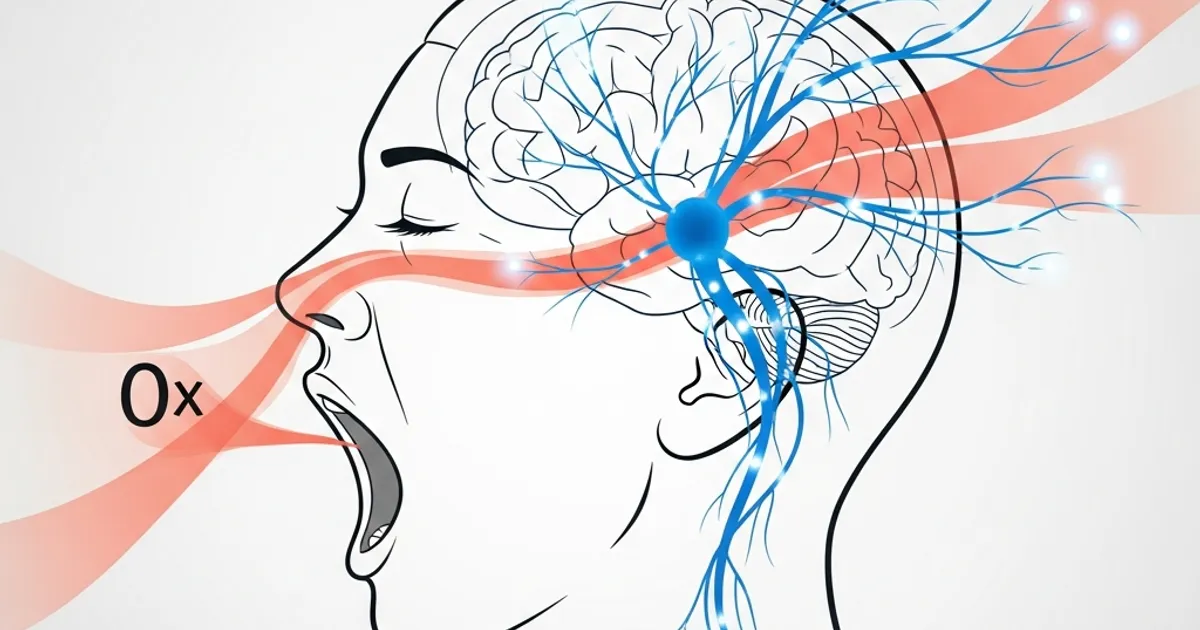
Exhaling activates the vagus nerve and the parasympathetic nervous system (rest and digest). An inhale/exhale ratio of 1:2 (for example, 4 seconds inhale, 8 seconds exhale) induces deep relaxation and improves your CO₂ tolerance over time.
4. Incorporate breathing pauses
After each exhale, introduce a pause of 2 to 5 seconds before inhaling. This progressively increases your CO₂ tolerance — the key factor in breathing age. It's the BOLT test principle applied to training: your body learns to function with slightly higher CO₂ levels.
5. Move while breathing through your nose
During physical activities (walking, jogging, cycling), maintain exclusive nasal breathing. If you need to open your mouth, the intensity is too high for your current level. Within a few weeks, you'll find you can maintain higher intensity while breathing through your nose.
What results to expect
With regular practice of 10 to 15 minutes per day, here is an indicative progression (it varies a lot from person to person):
- Week 1-2: awareness of your breathing patterns. First effects on perceived stress.
- Week 3-4: your BOLT score often starts to improve by a few seconds. Some people find it easier to fall asleep.
- Month 2-3: nasal breathing becomes automatic. Energy up, anxiety down.
- Month 6+: well-established habits. Your breathing age reflects the progress made since your first test.
The BreathLife app guides you through this process with exercises adapted to your current level and progress tracking that shows your improvements week by week.
Conclusion
Your breathing age is one of the most actionable health indicators that exist. Unlike cholesterol or blood pressure, you can improve it without medication, without equipment, and by dedicating only 10 minutes per day. The first step? Measure where you stand today with a simple breath-hold test.
To better understand CO₂'s central role in your breathing capacity, see our guide on CO₂: your body's hidden ally.