
Key takeaways
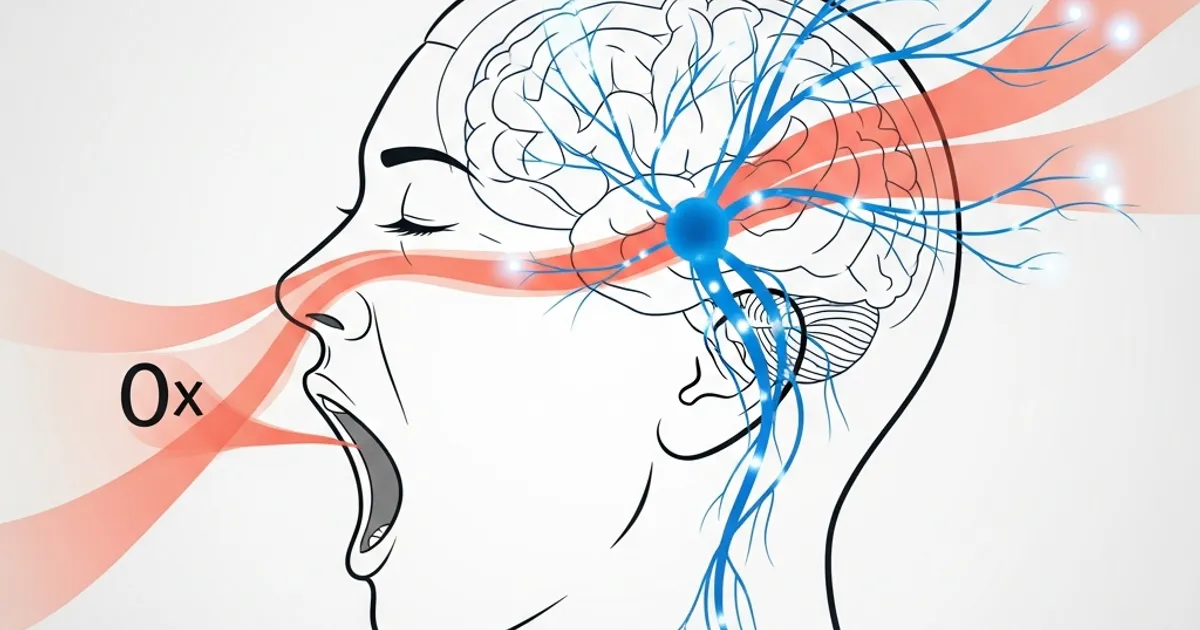
Lung capacity and longevity are closely linked. Two major American cohorts, Framingham (Kannel, Hubert, and Lew, 1983) and the Buffalo Health Study (Schünemann et al., 2000), found that lower vital capacity or FEV1 is associated with higher mortality, independently of smoking and age. Lung function declines naturally with the decades, but how fast it declines depends partly on your habits, and breathing training can help maintain it.
- In the Framingham study, vital capacity was inversely associated with the risk of cardiovascular disease and death, in men and women alike, including nonsmokers.
- In the Buffalo Health Study (1,195 adults followed for 29 years), participants in the lowest fifth of FEV1 had close to twice the all-cause mortality of those in the highest fifth.
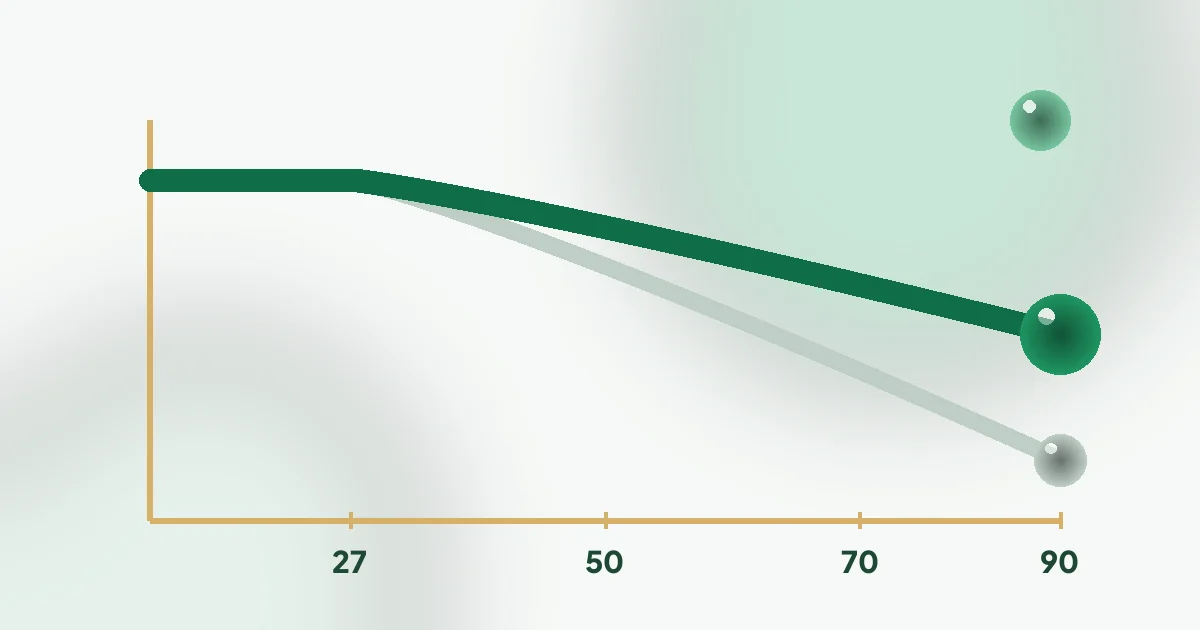
- A commonly cited order of magnitude: lung capacity drops 10 to 15% per decade after age 25-30; FEV1 falls by roughly 25 to 30 mL per year after age 35-40 according to the review by Sharma and Goodwin (2006).
- Smoking, inactivity, slumped posture, mouth breathing, and chronic over-breathing speed up the decline.
- Respiratory muscle training improves exercise performance in a meta-analysis of 46 studies (Illi et al., 2012). The 60-second breathing age test gives you a measurable starting point.
What is lung capacity and how is it measured?
Lung capacity describes how much air your lungs can move and how fast they can move it. In medicine it is measured by spirometry, a forced blow into a mouthpiece connected to a sensor. Two numbers matter most. Forced vital capacity (FVC) is the total volume you can exhale after a maximal inhale, typically 3 to 5 liters in an adult depending on height, sex, and age. FEV1, forced expiratory volume in one second, is the share of that volume you push out during the first second. The FEV1/FVC ratio is used to detect airway obstruction.
These values are compared with reference norms by age, height, and sex. That is where the idea of "lung age" comes from: the age at which your FEV1 would be normal for a healthy person. BreathLife applies the same logic in a different form, respiratory age, computed not with a spirometer but with a breath hold test.
The breath hold test measures something other than volume: how sensitive your nervous system is to carbon dioxide. After a normal exhale, you hold your breath and time how long until the first urge to breathe. We cover the mechanism in our article on CO₂ tolerance. Spirometry and the breath hold test are not interchangeable: the first measures the machine, the second measures how you use it all day long.
Why would a single breath predict lifespan? Good lung function reflects a supple rib cage, strong respiratory muscles, and lungs that transfer oxygen into the blood efficiently; it is also a marker of overall fitness and of low chronic inflammation, two factors tied to cardiovascular health. In October 2026, BreathLife's founder attended a three-day workshop in Vienna with breathwork teacher Dan Brulé, where this link between lung capacity and longevity was presented as one of the foundations of the practice.
How to maintain your lung capacity, step by step
Here is a concrete program, from the simplest step to the most demanding.
- Measure your baseline. Take the 60-second breath hold test, seated, after a normal exhale. Write down the time and repeat it every two weeks, in the morning, under the same conditions.
- Breathe through your nose, day and night. The nose filters the air, slows the airflow, and produces nitric oxide that widens the airways. If you wake up with a dry mouth, read our comparison of nasal vs. mouth breathing.
- Restore range of motion to the diaphragm. Five minutes a day of belly breathing with an exhale twice as long as the inhale (4-8, then 5-10). Upright spine, shoulders down, belly rising on the inhale.
- Practice cardiac coherence. Six breaths per minute (5 s in, 5 s out) for 5 minutes, ideally three times a day. This pace amplifies heart rate variability, a marker of nervous system resilience.
- Add gentle breath holds. Three times a week, 6 cycles of 4-4-4-8 (inhale, hold, exhale, empty-lung hold), released at the first urge to breathe. Never in water, never after hyperventilating.
- Move and strengthen. 150 minutes of endurance activity a week keeps lungs and heart in shape; an inspiratory muscle training device can add to this in sedentary or older people.
Common mistakes: trying to "fill" the lungs on every breath (which keeps over-breathing alive), mouth breathing outside of sessions, ignoring posture at the screen, and quitting after two weeks. Gains come in seconds per month, not per day.
Benchmarks: age-related decline and BreathLife levels
The lungs peak around age 20-25, then lose volume and speed. The most cited order of magnitude is a loss of 10 to 15% per decade after age 25-30. Sharma and Goodwin (2006) describe the mechanics: FEV1 drops by roughly 25 to 30 mL per year from age 35-40, and that rate can double after 70; the chest wall stiffens, the respiratory muscles weaken, and the gas exchange surface shrinks. These are averages: between two 60-year-olds, the gap can be huge depending on smoking, physical activity, and breathing habits.
The BreathLife test does not replace spirometry, but it gives you a daily benchmark.
| Level | Breath hold time | What it suggests | Indicative 8-week goal | Recommended exercises and rhythms |
|---|---|---|---|---|
| Strained | under 10 s | Fast, upper-chest breathing, low CO₂ tolerance | 10 to 12 s | Steady Heart 4-4, Deep Reset 4-8, Gentle Hold 4-4-4-6 |
| Tired | 10 to 15 s | Slightly oversized breathing, nose underused | 15 s | Steady Heart 5-5, Deep Reset 5-10, Gentle Hold 4-4-4-8 |
| Optimal | 15 to 20 s | Calm resting breathing, room to improve | 20 s | Steady Heart 6-6, Deep Reset 8-16, Gentle Hold 5-5-5-10 |
| Efficient | 20 to 25 s | Good CO₂ tolerance, economical breathing | 25 s | Steady Heart 10-10, Deep Reset 10-20, Gentle Hold 6-6-6-12 |
| Exceptional | over 25 s | Slow, silent breathing at rest | Maintenance, 30 to 40 s long term | Steady Heart 14-14, Deep Reset 12-24, Gentle Hold 7-7-7-14 |
Exact thresholds shift with age: a 15-second hold does not mean the same thing at 25 and at 70, which is what respiratory age captures. Stay at your measured level for at least two weeks before moving up.
Lung function and life expectancy: what the science says
The link between breathing and longevity rests on cohorts followed for decades. The first signal came from Framingham, the cardiovascular study running in Massachusetts since 1948. Kannel, Hubert, and Lew (1983) analyzed participants' vital capacity and found it inversely associated with the risk of cardiovascular disease and mortality, in men and women alike. The association held after adjusting for age and among nonsmokers, suggesting that vital capacity was doing more than reflecting tobacco damage.
The Buffalo Health Study confirmed and extended the finding. Schünemann et al. (2000) followed 1,195 adults aged 20 to 89 for 29 years. Participants whose FEV1 sat in the lowest fifth for their age had close to twice the all-cause mortality of the highest fifth, and the risk rose step by step from one quintile to the next. The authors conclude that lung function predicts long-term mortality in the general population.
Sin, Wu, and Man (2005) then pooled these data in a systematic review published in Chest: reduced lung function is associated with excess cardiovascular mortality, most markedly in the lowest FEV1 quintile. They point to low-grade systemic inflammation as a shared mechanism between lungs and arteries. Calm breathing that keeps CO₂ at a normal level helps release oxygen to the tissues and keeps blood vessels dilated, as we explain in CO₂, a health ally.
Can you do something about it? Several avenues are supported. Illi et al. (2012) pooled 46 studies in a meta-analysis: respiratory muscle training improves exercise performance in healthy people, with a larger effect in the less fit. Cardiac coherence, breathing at about six cycles per minute, increases heart rate variability, an indicator whose decline is associated with aging and cardiovascular risk. And CO₂ tolerance training lengthens breath hold time within weeks and slows resting breathing.
Let us be precise: this research shows that higher lung function is associated with a longer life; it does not prove that training extends life. The studies do suggest that the decline can be slowed and that intermediate markers (respiratory muscle strength, HRV, CO₂ tolerance) improve.
When to worry and see a doctor
A short breath hold time is not a diagnosis. Some signals, however, warrant a medical visit and spirometry, a simple, painless test. See a doctor if you get out of breath doing something that was easy a year ago, if you have been coughing for more than eight weeks, if you hear wheezing when you exhale, if you snore loudly with breathing pauses noticed by your partner, or if your breath hold time stays under 10 seconds despite six weeks of regular practice. Smokers and former smokers over 40 should ask for a baseline spirometry even without symptoms: early airway obstruction is silent.
Never hold your breath in water, while driving, or standing if you are prone to dizziness. Never hyperventilate before a hold. If a practice causes lightheadedness, tingling, or chest tightness, stop and return to quiet nasal breathing. BreathLife is not a medical device. If you have a respiratory or heart condition, are pregnant, or have epilepsy, ask your doctor before starting.
Spirometry, breath hold test, VO₂max, HRV: comparing the measures
| Measure | What it assesses | Where and how | Link with longevity |
|---|---|---|---|
| Spirometry (FEV1, FVC) | Lung volume and airflow, airway obstruction | Doctor's office or pulmonologist, 15 minutes, forced exhale | Best documented: Framingham, Buffalo, Sin et al. review |
| Breath hold test (BOLT, respiratory age) | CO₂ tolerance, quality of resting breathing | At home, 60 seconds, after a normal exhale | Indirect: marker of dysfunctional breathing, responsive to training |
| VO₂max | Maximal oxygen uptake, cardiorespiratory fitness | Lab exercise test or watch estimate | Strongly associated with mortality in fitness cohorts |
| Heart rate variability (HRV) | Autonomic nervous system balance, recovery | Watch or chest strap, at rest or overnight | Low HRV is associated with cardiovascular risk; responds to cardiac coherence |
Spirometry remains the reference for a one-off checkup; the breath hold test is the best daily tracking tool, free, repeatable, and directly tied to the exercises you practice. VO₂max and HRV round out the picture if you own a wearable.
In BreathLife: the free test and ten exercises matched to your level
The BreathLife app was built around this link between lung capacity and longevity. The free 60-second breathing age test places you in one of five levels. The app's ten exercises, from "Steady Heart" (cardiac coherence) to "Gentle Hold" (empty-lung holds) and "Deep Reset" (belly breathing), then adapt their rhythms to your level automatically: a Strained beginner practices a 4-4-4-4 box while an Exceptional practitioner follows 11-11-11-11. The guided voice, in English or French, announces each phase; sessions last 3, 5, or 10 minutes; the daily streak, the joker, and the Sunday group session at 8 pm help you stick with it. For the full picture, see our guide to the ten breathing exercises.
Conclusion
Your lung capacity says something about your future: Framingham and Buffalo showed it, recent reviews confirmed it. It declines with age, but part of that decline depends on simple habits: breathing through the nose, restoring the diaphragm's range, slowing the pace, tolerating a little more CO₂, moving. No promise of longevity here, only a daily habit whose effects you can measure. Start by learning your baseline: take the free breathing age test, then let the exercises adapt to your level.