
Key takeaways
A yawn is an involuntary reflex: a long, deep inhale with the mouth wide open, a brief pause with full lungs, then a shorter exhale, with a stretch of the jaw, throat and face. The science of yawning still cannot say for certain why we yawn: the most studied hypotheses point to brain cooling, a shift between states of alertness, and social synchronization. Two things are settled: it is not about a lack of oxygen, and holding a yawn in gains you nothing.
- About 6 seconds: the average length of a human yawn, the longest among the mammal species compared by Gallup and colleagues in 2016.
- From the first trimester of pregnancy, the fetus already yawns; the reflex exists in fish, birds and every mammal.
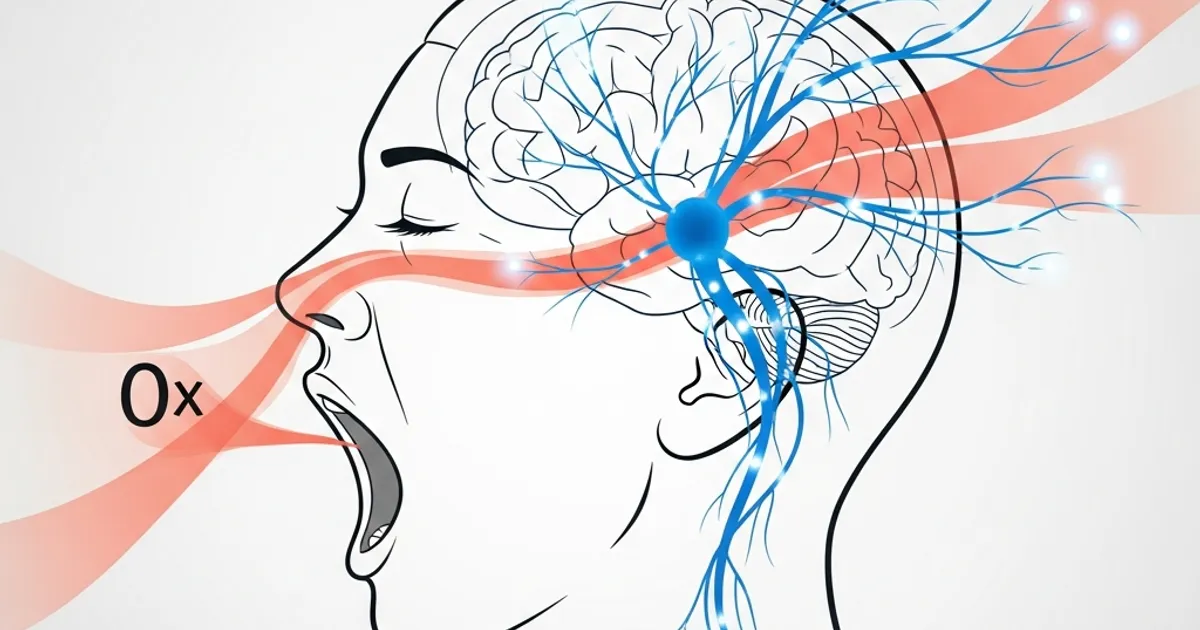
- Oxygen is not the cause: breathing air enriched with oxygen or CO₂ does not change how often people yawn (Provine, 1980s).
- Contagious from around age 4 or 5: contagion emerges along with empathy and is stronger between people who are close.
- 3 to 5 deliberate yawns are enough to loosen the throat and jaw before a breathing session or public speaking.
What is a yawn? Anatomy of a reflex
A full yawn unfolds in three phases. First a slow inhale, 4 to 5 seconds, during which the mouth opens as wide as it can, the diaphragm drops and the rib cage expands. Then a peak, a fraction of a second when everything is under tension: jaw muscles stretched, pharynx open, eyes closed, tear glands squeezed (hence the watery eyes), tensor tympani muscle contracted (hence the ears that "pop"). Finally a fast exhale, sometimes noisy, followed by a distinct sense of release.
The reflex is driven by the brainstem and the hypothalamus: you cannot really decide not to yawn, only disguise it.
What a yawn does to your breathing
In respiratory terms, yawning and breathing deeply on purpose have a lot in common. The inhale of a yawn is one of the fullest the body produces on its own: the diaphragm drops completely, the intercostal muscles stretch, and the regions of the lungs that barely work during shallow breathing fill up again. This reopening of the alveoli is exactly the role assigned to the physiological sigh, the double inhale we all produce several times an hour without noticing. The difference lies in the mouth, jaw and throat, which only the yawn recruits. A yawn is also, in effect, a free, full diaphragmatic breath.
Why we suppress it, and why you should let it come
In most cultures, yawning in public reads as boredom or rudeness. So we clench our teeth, cover our mouth, and inhale through the nose with the jaw shut. That stifled yawn is incomplete: the inhale is cut short, the throat never stretches, and the urge returns a few seconds later. Letting a yawn come means accepting those 6 seconds with an open mouth, even if you turn away. It is one of the few moments when mouth breathing is legitimate; once the yawn is over, nasal breathing takes over again.
Conscious yawning, step by step
Conscious yawning means deliberately triggering three to five full yawns to relax the throat, jaw and upper body before a breathing session, a talk, or bedtime. During a three-day breathwork retreat in Vienna with Dan Brulé in October 2026, BreathLife's founder tried deliberate yawning as the opening of every session and has kept the habit since.
- Get set, seated or standing, shoulders down, neck long, teeth unclenched.
- Open your mouth wide and inhale slowly through mouth and nose together, letting the jaw drop as if you were about to yawn. The first few times, you are "acting out" the yawn.
- Let the real reflex take over. On the second or third attempt, a genuine yawn almost always kicks in: the eyes close, tears may come, a sound may escape. Hold nothing back.
- Exhale without controlling it, then take two or three normal nasal breaths.
- Repeat three to five times. If the urge to stretch shows up, follow it.
- Move on to your breathing session or your talk, with an open throat and a freer voice.
Common mistakes
- Forcing the jaw. Pain in front of the ear means the joint is being strained: open less.
- Hyperventilating between yawns. The breaths in between are calm and nasal.
- Stopping halfway. An interrupted yawn leaves the throat tense.
- Chasing a result. If no real yawn comes, three "acted" yawns already loosen the jaw.
How many deliberate yawns for your level
Conscious yawning has no timed rhythm. Your BreathLife level, measured by the breathing age test, mainly decides which exercise follows and at what pace; for the yawning itself, the number of repetitions varies little. The table gives benchmarks, not a prescription.
| Level | Deliberate yawns | Pause between yawns | Best time | Exercise that follows |
|---|---|---|---|---|
| Strained | 3 | 3 nasal breaths | Before sleep | "Deep Reset" 4-8, 3 min |
| Tired | 3 | 3 nasal breaths | Before sleep or after lunch | "Deep Reset" 5-10, 3 min |
| Optimal | 4 | 2 nasal breaths | Before a session or a talk | "Let Go" 8-16, 5 min |
| Efficient | 4 to 5 | 2 nasal breaths | Start of a session, cooling down after exercise | "Let Go" 10-20, 5 min |
| Exceptional | 5, with a stretch | 1 nasal breath | Opening a long session | "Deep Reset" 12-24, 10 min |
The test takes 60 seconds at most: after a normal exhale, hold your breath until the first clear urge to breathe, which reflects your CO₂ tolerance. As a rough guide: under 10 s, Strained; 10 to 15 s, Tired; 15 to 20 s, Optimal; 20 to 25 s, Efficient; over 25 s, Exceptional. The exact thresholds shift with age.
Why do we yawn? The scientific hypotheses
For a long time the popular explanation was a lack of oxygen. Robert Provine and colleagues tested it in the 1980s by having volunteers breathe air enriched with CO₂ or pure oxygen: yawning frequency did not budge. Since then, three hypotheses have shared the field, and they are not mutually exclusive.
Hypothesis 1: cooling the brain
Andrew Gallup and Gordon Gallup proposed in 2007 that yawning works as an air conditioner: the deep inhale and the stretch of the jaws would increase blood flow to the head and heat exchange, lowering brain temperature. In their experiment, participants who breathed only through the nose, or who held a cold pack against their forehead, yawned far less while watching videos of people yawning. In 2014, Massen and colleagues observed pedestrians in Vienna in summer and winter: contagion followed a "thermal window," lower in intense heat and in deep cold, highest around 20 °C (68 °F). Gallup and Eldakar reviewed this body of work in 2012; the hypothesis remains debated.
Hypothesis 2: switching states of alertness
Yawns cluster around transitions: on waking, before sleep, before an exam or a sporting event. They may accompany the shift from one state of arousal to another rather than tiredness alone. Olivier Walusinski suggested in 2014 that the inhale of a yawn could boost the flow of cerebrospinal fluid and help the brain switch from the "default mode network," the daydreaming state, to the attention network. It is a working hypothesis, rarely tested directly.
Hypothesis 3: synchronizing the group
Contagious yawning is the best documented strand. In Provine's 1986 experiments, watching videos of people yawning triggered a yawn in roughly half the viewers, and simply reading about yawning had a comparable effect. Platek and colleagues showed in 2003 that susceptibility to contagion goes hand in hand with self-face recognition and with "theory of mind" tasks, the ability to model what someone else is thinking. The work of Elisabetta Palagi and Ivan Norscia then showed that contagion is stronger between close individuals than between strangers, in humans and bonobos alike. The evolutionary reading: a group that yawns together would synchronize its levels of alertness.
Bigger brain, longer yawn
In 2016, Gallup, Church and Pelegrino compared yawn duration across many mammal species, from mice to elephants. Yawn duration was strongly correlated with brain weight and with the number of cortical neurons, far more than with body size; humans, at a little over 6 seconds, had the longest yawn. This result argues for a brain-oriented function rather than a lung-oriented one, without settling the question of cooling versus alertness.
What this means for your breathing
Whichever hypothesis wins, a yawn remains a complete diaphragmatic inhale offered by the body, followed by a release of the throat and face. The pharynx and larynx are richly supplied by the vagus nerve, and the ease that follows a full yawn is familiar to everyone. Let's stay careful: among the benefits of yawning, the loosening of the jaw and throat is the one you can count on; the rest is a matter of how it feels.
When yawning is a signal
Yawning a few times to around twenty times a day is ordinary, more so in hot weather, after a short night, or during a monotonous task. Yawning in a meeting says nothing about the speaker: it says your activation level is dropping. Take two full yawns rather than ten stifled ones.
What deserves attention
- Sleep deprivation. Bouts of daytime yawning are often the first sign of sleep debt; our breathing exercises for sleep help you fall asleep, not make up for nights that are too short.
- Certain medications. SSRI antidepressants, opioids (especially opioid withdrawal) and some dopaminergic treatments increase yawning. Mention it to the prescribing doctor, without stopping the treatment on your own.
- Excessive yawning. Dozens of yawns in a row, with no fatigue or heat to explain them, can precede a vasovagal episode or a migraine and sometimes accompany neurological conditions, as the 2018 review by Krestel, Bassetti and Walusinski points out. In that case, see a doctor.
When to skip deliberate yawning
Avoid triggering yawns if you have pain or a history of dislocation in the jaw joint, or after recent dental surgery. If dizziness appears, return to calm nasal breathing. BreathLife is not a medical device; if you have a respiratory or heart condition, are pregnant, or have epilepsy, ask your doctor before starting a breathing program.
Yawn, sigh, extended exhale: what is the difference?
| Technique | Rhythm | Main effect | Best time |
|---|---|---|---|
| Conscious yawning | 3 to 5 full yawns, mouth open, about 6 s each | Loose throat and jaw, full inhale | Before a session, a talk, or bedtime |
| Physiological sigh | Double nasal inhale, long mouth exhale, 1 to 3 times | Fast drop in arousal, alveoli reopened | At the peak of stress, in 30 seconds |
| Extended exhale 4-8 | Inhale 4 s, exhale 8 s, 10 cycles | Deep relaxation, vagal brake | End of day, winding down |
| Diaphragmatic breathing | Belly expands, 6 to 10 breaths per minute | Foundation of every slow technique | Every day, while learning |
The yawn is the only one of these four that is a reflex: you invite it, you do not command it. For a talk, pair it with our guide to breathing for public speaking.
How BreathLife works with yawning
There is no "yawning" exercise in the BreathLife app, and that is deliberate: you cannot put a reflex on a timer. What we recommend is opening each session by letting one or two yawns come, then launching "Deep Reset" (belly breathing with an exhale twice as long as the inhale, from 4-8 to 12-24 depending on your level) or "Let Go" (extended exhale, from 4-8 to 12-24), for 3, 5 or 10 minutes, with the guided voice in English or French. Every session counts toward your daily streak, with a free pass if you miss a day, and the Sunday group session at 8 pm is a good moment to try this warm-up.
Conclusion
We do not yet know exactly why we yawn, but we do know what a yawn does: a deep inhale, a stretch of the throat and jaw, an immediate release. The brain-cooling, alertness-shift and social-synchronization hypotheses complement each other more than they compete. Let it come, trigger three to five before you breathe or speak, and see a doctor if yawning becomes overwhelming. To choose the exercise to follow it with, take the free breathing age test: 60 seconds is all it takes.