
Introduction: the psychedelic you carry within
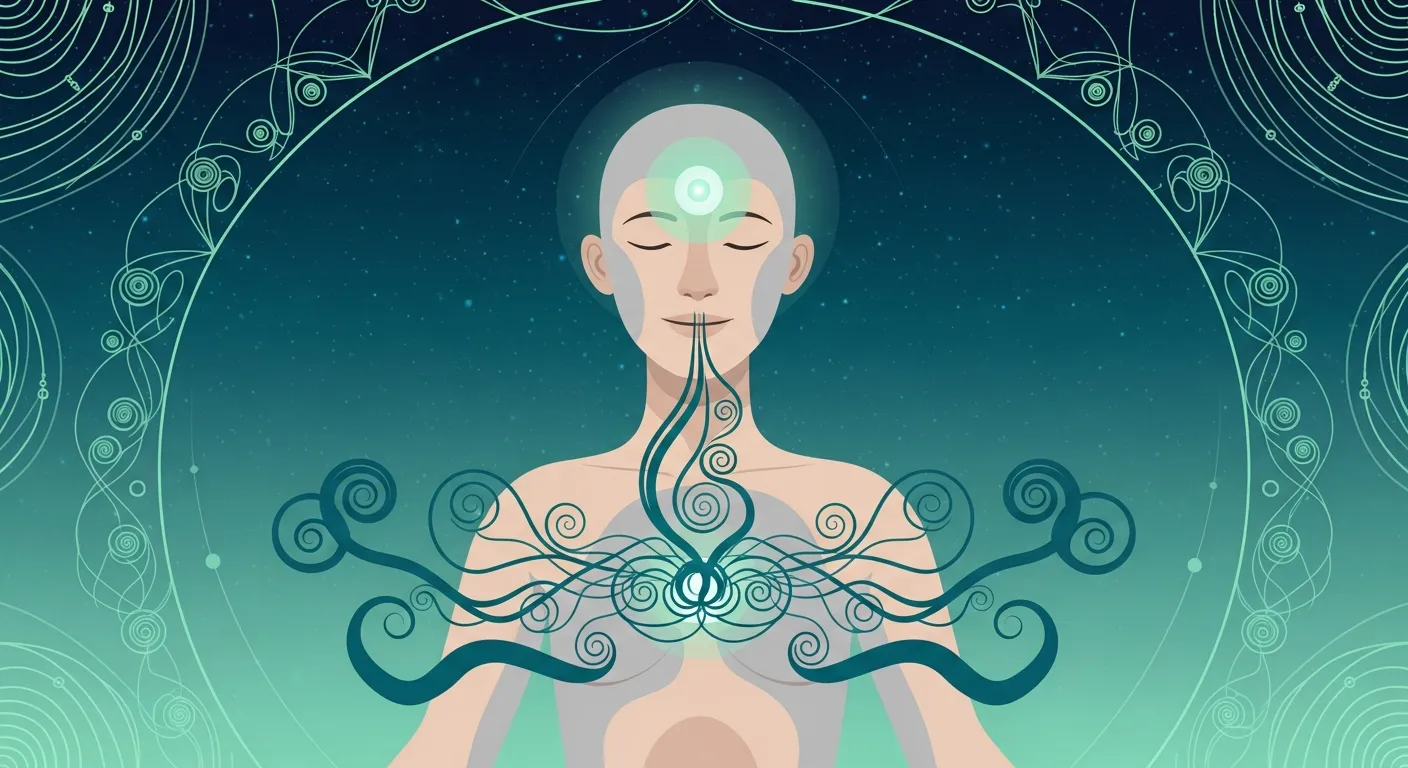
Imagine a substance that can trigger visions, dissolve ego boundaries, induce profound euphoria, heal buried traumas, and reconnect you to a feeling of cosmic unity. Now imagine that this substance is free, legal, and self-produced. That substance is your breath — or more precisely, what your breath can trigger in your brain when used in specific ways.
For millennia, shamans, yogis, Sufi mystics, and Buddhist monks have used breathing to reach altered states of consciousness. Modern science is beginning to understand why: manipulating the O₂/CO₂ ratio in the blood triggers a neurochemical cascade that literally alters perception, emotions, and consciousness. This isn't magic or placebo — it's neurochemistry.
The science behind the breathing "high"
What happens in your brain
When you practice intense, rapid breathing (controlled hyperventilation), several mechanisms activate simultaneously:
- Respiratory alkalosis: hyperventilation massively expels CO₂, making the blood more alkaline. This alkalosis reduces cerebral blood flow by 30-40%, creating transient cerebral hypoxia — a state similar to "near-death experiences."
- Default Mode Network (DMN) suppression: the DMN is the brain network responsible for the "self," internal narration, and rumination. Its suppression is associated with mystical experiences, ego dissolution, and a sense of unity — exactly like under psilocybin or LSD.
- Neurotransmitter release: hyperventilation triggers massive release of serotonin, dopamine, endorphins, and potentially endogenous DMT (dimethyltryptamine, the "natural psychedelic" produced by the pineal gland).
- Limbic system activation: buried emotions, body memories, and stored tensions are released, explaining the crying, laughter, and trembling often observed during intense breathwork.
The endogenous DMT question
DMT is a fascinating molecule. It's structurally identical to classic psychedelics (psilocybin, LSD) and produces similar experiences: geometric visions, ego dissolution, cosmic unity. Dr. Rick Strassman dubbed it "the spirit molecule."
The human body naturally produces DMT — it's been detected in blood, urine, and cerebrospinal fluid. In 2019, University of Michigan researchers showed that rat brains produce DMT in significant quantities, and production increases massively during cardiac arrest.
The hypothesis, still debated, is that certain intensive breathing techniques stimulate endogenous DMT production, explaining the visions and mystical experiences reported by practitioners. Definitive proof is still lacking, but the parallels between experiences reported under exogenous DMT and intense breathwork are striking.
Techniques that get you "high"
1. Holotropic Breathwork
Developed in the 1970s by psychiatrist Stanislav Grof (a pioneer in LSD research) after the ban on therapeutic LSD. Grof discovered that fast, deep breathing could reproduce the same states of consciousness as LSD — visions, childhood regression, transpersonal experiences.
Protocol:
- Lying on your back, eyes closed, evocative music (percussion, tribal music, orchestral crescendos).
- Fast, deep, continuous breathing through the mouth. No pause between inhale and exhale. Rhythm is about 2-3 times faster than normal.
- Duration: 1-3 hours.
- A trained "sitter" (companion) is mandatory.
What people report: kaleidoscopic visions, reliving childhood or birth memories, intense emotional release (crying, screaming, laughing), sensation of body dissolution, profound spiritual experiences, feeling of universal connection.
Major precaution: never practice alone. Released emotions can be very intense. Holotropic breathing is contraindicated for people with psychotic disorders, epilepsy, serious cardiac problems, or pregnancy.
2. The Wim Hof Method — intense version
The standard Wim Hof method (30 deep breaths followed by retention) already produces a mild "high": tingling, lightness, mental clarity. The extended version intensifies the experience:
- 4-5 rounds of 30-40 deep, fast breaths through the mouth.
- After each round: complete exhale, retention as long as possible (target: 2-3 minutes).
- During retention, some practitioners add abdominal "pumps" (Nauli) to intensify the effect.
What people report: intense euphoria, full-body tingling, floating sensation, mild geometric visions, profound sense of peace and clarity.
Mechanism: alternating between hyperventilation (alkalosis) and retention (hypoxia + hypercapnia) creates a neurochemical "rollercoaster" that amplifies dopamine and endorphin release.
3. Rebirthing (Connected Breathing)
Developed by Leonard Orr in the 1960s. Breathing is continuous, circular, without pauses — each exhale immediately followed by an inhale, creating a constant flow.
- Lying down, eyes closed.
- Breathing through the mouth, continuous, no pauses. Inhale is active, exhale is passive.
- Duration: 45 min to 1.5 hours.
- Accompaniment by a trained practitioner is mandatory.
What people report: reliving birth (hence the name), release of deep physical tensions (hand and foot tetany common at first), emotional waves, feeling of "rebirth."
4. The "DMT Breath" technique
Popularized on social media (with caution needed regarding online information), this technique combines intense hyperventilation with prolonged retention:
- 30 powerful, fast breaths through the mouth (fully empty and fill your lungs).
- Big inhale, full-lung retention, perineum and diaphragm contraction (bandhas in yoga) for 15-30 seconds.
- Slow exhale. Immediately start a new round.
- 3-5 rounds.
Precaution: this technique produces intense effects and is not for beginners. Never practice in water, while driving, standing, or alone without prior experience.
What practitioners report
Experiences vary considerably, but certain themes recur constantly:
- Physical phase (first 5-10 minutes): tingling in hands and face, vibration sensation, mild finger tetany, temperature changes, dizziness.
- Emotional phase (10-30 minutes): rising emotions — joy, sadness, anger, gratitude. Spontaneous crying or laughter. Sensation of "emptying an emotional reservoir."
- Transpersonal phase (30+ minutes): dissolution of body boundaries, sensation of consciousness expansion, visions (colors, geometric shapes, scenes), feeling of unity with "something greater," encounter with "presences," reliving ancient memories.
- Integration phase (after session): profound serenity, mental clarity, feeling of lightness, sometimes physical fatigue, insights about personal issues.
Essential safety rules
The breathing "high" is not without risks. Here are the non-negotiable rules:
- NEVER practice in water (pool, bath, shower). Hyperventilation followed by retention can cause sudden loss of consciousness ("blackout") — drowning within seconds. This is the most common breathwork-related cause of death.
- Never practice standing or while driving.
- Always practice lying down, in a safe environment, with someone who knows the technique.
- Absolute contraindications: epilepsy, psychotic disorders (schizophrenia, unstabilized bipolar), aneurysm, serious cardiac problems, pregnancy, glaucoma, retinal detachment.
- Relative contraindications: severe unaccompanied PTSD, severe asthma, uncontrolled hypertension.
- Start gradually: don't jump straight into a 3-hour holotropic session. Start with the Wim Hof method (15 minutes) and increase gradually.
Breathwork vs psychedelics: similarities and differences
Neuroimaging research shows striking parallels between intense breathwork experiences and psychedelic states:
- Similarities: DMN suppression, ego dissolution, geometric visions, emotional release, spiritual insight, sense of unity, time perception alteration.
- Differences: breathwork offers total control — you can stop at any time by breathing normally (return to normal in 2-3 minutes). A psychedelic trip lasts 6-12 hours with no stop option. Breathwork creates no addiction or tolerance. There's no "bad trip" in the classic sense, though difficult emotions may emerge.
Dr. Stanislav Grof, who conducted over 4,000 therapeutic LSD sessions AND thousands of holotropic breathing sessions, stated that breathing is "as powerful as LSD for accessing non-ordinary states of consciousness, but safer and more controllable."
Integration: the most important part
The experience itself is only half the process. Integration — what you do with the experience afterward — is what produces lasting change:
- Journaling: immediately after the session, write everything down — sensations, emotions, visions, insights. Details fade quickly.
- Rest: don't plan anything intense afterward. The process continues working in the hours and days that follow.
- Sharing: talking about the experience with someone you trust helps integrate it.
- Action: if an insight emerges (a relationship to repair, a habit to change, an emotion to express), take action in the following days.
Conclusion
Your breathing is the oldest vehicle for exploring the territories of consciousness. From the caves of Siberian shamans to Stanford laboratories, the message is the same: voluntarily modifying your breathing modifies your brain — deeply, powerfully, and reproducibly. No external substances needed: the safest psychedelic in the world is between your ribs. But like any powerful tool, it demands respect, preparation, and caution.
For a gentler exploration of these territories, discover breathing during pregnancy and breathing and creativity — two unexpected facets of conscious breath.