
Introduction: your breath changes during pregnancy
From the very first weeks of pregnancy, your breathing transforms. Progesterone stimulates the breathing centers: from the first trimester, the volume of air breathed per minute increases (by up to almost 50%), mainly because each breath becomes deeper — the rate itself barely changes. Later, the diaphragm rises under uterine pressure. About 7 in 10 pregnant women feel breathless, often from the first trimester — well before the belly is visible (LoMauro and Aliverti, 2015).
Conscious breathing is a valuable tool during pregnancy. It can help you ride out nausea, reduce anxiety, prepare for labor, and support postpartum recovery. Midwives commonly teach it; a Turkish controlled trial (Yuksel et al., 2017, 250 women) found slightly less pain and a shorter pushing stage among women guided through breathing exercises.
First trimester: calming nausea and anxiety
The first trimester is often marked by nausea, fatigue, and anxiety about this upheaval. Breathing can help on all three fronts.
Anti-nausea breathing
Pregnancy nausea is mainly hormonal, and breathing won't make it go away. But slow breathing helps you ride out a wave of nausea by easing the discomfort and anxiety that come with it.
- Sit comfortably and inhale slowly through your nose for 4 seconds.
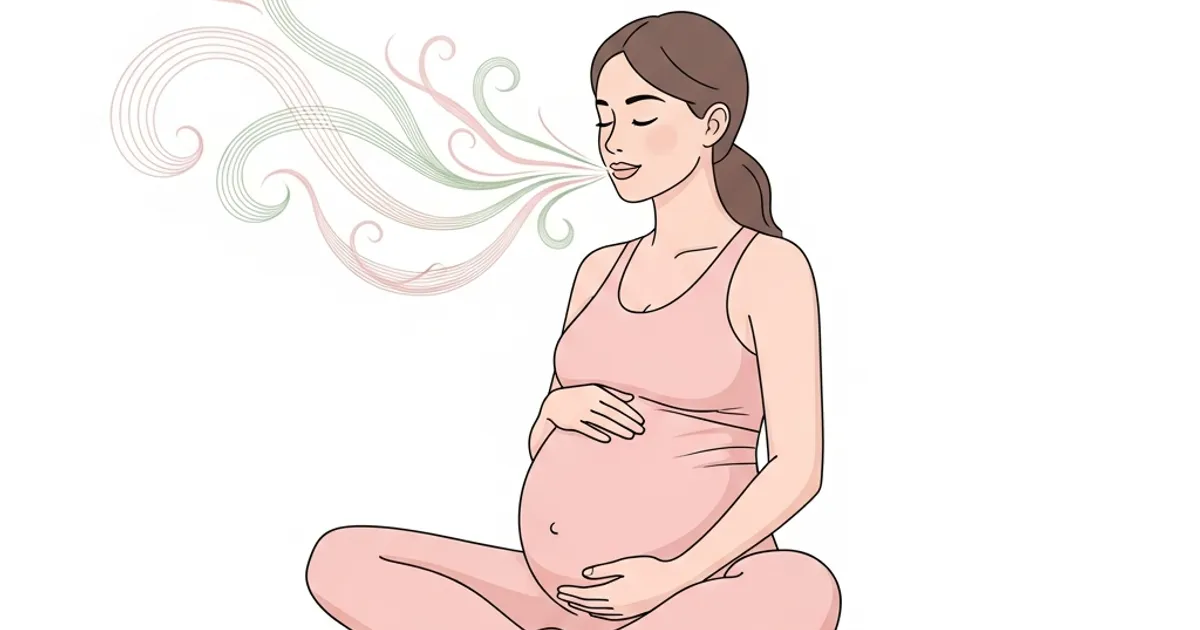
- Exhale gently through your mouth for 6 seconds, as if blowing on a candle without extinguishing it.
- Focus on the coolness of air on inhalation and the release on exhalation.
- Practice for 3-5 minutes whenever nausea appears.
Gentle cardiac coherence
Cardiac coherence, gentle and without breath holds, is suitable during pregnancy. Practice 5 minutes, 3 times daily: inhale 4 seconds, exhale 6 seconds. The slightly longer exhalation promotes calm without causing dizziness.
Second trimester: adapting to a changing body
From week 14, the uterus rises and the diaphragm has less space. It's time to adapt your practice.
Lateral costal breathing
Rather than classic abdominal breathing, favor lateral rib expansion:
- Place your hands on the sides of your ribs, thumbs toward the back.
- Inhale feeling your ribs expand laterally under your hands.
- Exhale feeling the ribs gently come together.
- This technique allows deep breathing without compressing the belly.
Adapted positions
As the belly grows, lying on your back can compress the vena cava. Practice:
- On your left side: the ideal position for blood circulation.
- Seated slightly reclined: supported back, relaxed shoulders.
- On all fours: excellent for back relief and costal breathing practice.
Third trimester: preparing for birth
The last trimester is the time to master techniques that will accompany you on the big day.
Breathing for contractions
During contractions, the natural tendency is to hold your breath and tense up. That's exactly the opposite of what helps. The recommended technique:
- Start of contraction: big inhale through the nose, slow and deep.
- During the contraction: exhale slowly through the mouth making a low sound ("oooh" or "aaah"). The low sound helps relax the jaw and upper body; many midwives recommend it.
- Between contractions: breathe normally, enjoy the recovery.
Pushing breathing
"Expiratory pushing" is now preferred by midwives:
- Inhale deeply at the start of the contraction.
- Push while exhaling, as if inflating a resistant balloon.
- Breath-hold pushing (Valsalva maneuver) hasn't shown a clear advantage: a Cochrane review (Lemos et al., 2017) found no clear difference between spontaneous and directed pushing, including for perineal tears. Follow your midwife's guidance.
Postpartum recovery
After delivery, breathing is your first ally for recovery:
- Diaphragm reconnection: from the first days, breathe gently feeling your belly rise. No abdominal exercises before medical clearance.
- Baby blues management: cardiac coherence (5 min, 3×/day) can help you settle during this emotionally intense period. If low mood lasts more than two weeks, talk to a health professional.
- Pelvic floor rehabilitation: coordinate breathing with Kegel exercises — contract on exhale, release on inhale.
Safety and contraindications
Gentle breathing without breath holds carries no known risk during pregnancy. However, avoid:
- Hyperventilation techniques (like intense breathwork).
- Prolonged breath holds (more than 5 seconds).
- Wim Hof or Kapalabhati-type techniques.
- Any technique that causes dizziness or discomfort.
For high-risk pregnancies, preeclampsia, or complications, consult your midwife or obstetrician before any practice.
Conclusion
Conscious breathing is the thread running through your pregnancy: from the first trimester where it calms nausea and anxiety, to labor where it becomes a valuable tool, and postpartum where it supports recovery. A few minutes a day is all it takes. Your body knows how to breathe for two — you just need to listen and support it.