
Introduction: beyond wellness
For a long time, conscious breathing was relegated to the "wellness" aisle — somewhere between essential oils and healing crystals. That era is over. Since 2015, the number of clinical trials on breathing techniques has exploded, and the results are robust enough that universities like Stanford, Harvard, and Oxford are integrating breathing into their psychiatric research protocols.
This article isn't about "feeling better." It's about data. Randomized controlled trials. Meta-analyses. What the most rigorous science says about the impact of breathing on anxiety, depression, PTSD, and sleep disorders. The results are both surprising and encouraging.
Neurobiological mechanisms
Before examining the studies, it's essential to understand why breathing affects mental health. This isn't a placebo effect — these are identified and measurable neurobiological mechanisms.
The respiratory-emotional axis
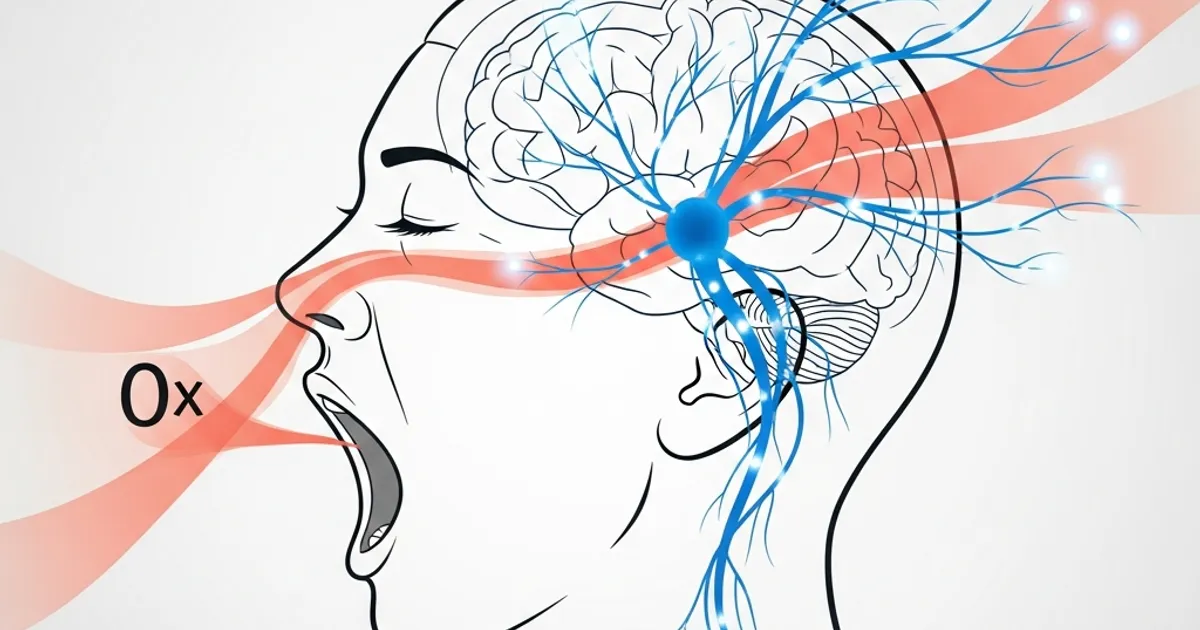
In 2017, Stanford researchers discovered a group of neurons in the brainstem (the "respiratory pacemaker" or pre-Bötzinger complex) that directly connects breathing rhythm to the arousal and anxiety center (the locus coeruleus). When breathing is fast, these neurons activate the locus coeruleus, which produces noradrenaline — the neurotransmitter of alertness and anxiety. When breathing is slow, these neurons reduce locus coeruleus activity.
This is a direct circuit, hardwired in the brain. No need to meditate for 20 minutes to "calm the mind" — simply slowing breathing changes brain chemistry in real time.
The vagus nerve and the gut-brain axis
80% of vagus nerve fibers are afferent — they carry information from organs to the brain. When diaphragmatic breathing stimulates the vagus nerve, the brain receives the signal "everything is fine, organs are functioning normally." This signal reduces amygdala activity (the fear center) and increases prefrontal cortex activity (the rational decision center).
Cortisol and the HPA axis
The hypothalamic-pituitary-adrenal (HPA) axis is the body's stress response system. When chronically activated, it produces excess cortisol that damages the hippocampus (memory), dysregulates serotonin (mood), and disrupts sleep. Slow breathing reduces HPA axis activity, normalizing cortisol levels within 5-10 minutes.
Brain waves
EEG shows that slow breathing increases alpha waves (8-13 Hz, associated with alert relaxation) and theta waves (4-8 Hz, associated with deep meditation). It reduces fast beta waves (>20 Hz, associated with anxiety and rumination).
Breathing and anxiety: the evidence
Anxiety is the most prevalent mental disorder worldwide (264 million people according to WHO). It's also the one for which evidence supporting breathing is strongest.
The Stanford 2023 study (physiological sigh)
The most publicized study in recent years. Published in Cell Reports Medicine, it compared 4 interventions of 5 minutes per day for 1 month in 114 participants:
- Physiological sigh (double inhale + long exhale).
- Box breathing (4-4-4-4).
- Cyclic hyperventilation (Wim Hof type).
- Mindfulness meditation.
Result: all breathing techniques outperformed meditation for anxiety reduction and mood improvement. The physiological sigh produced the best results, with a significant reduction in baseline respiratory rate (indicator of improved vagal tone).
The Frontiers in Psychology 2023 meta-analysis
This analysis of 16 controlled trials (1,200+ participants) concluded that slow breathing techniques:
- Significantly reduce anxiety scores (GAD-7) (p < 0.001).
- Reduce salivary cortisol by 15-25%.
- Improve HRV by 10-20%.
- Effects are comparable to SSRIs (selective serotonin reuptake inhibitors) in the short term — without the side effects.
Breathing vs benzodiazepines
A University of São Paulo study (2021) compared diaphragmatic breathing to alprazolam (Xanax) in patients with generalized anxiety disorder. After 8 weeks, both groups showed similar anxiety symptom reduction. But the "breathing" group had no side effects, no dependency risk, and maintained benefits 3 months after stopping practice — unlike the medication group, which relapsed.
Breathing and depression: promising leads
Data on depression is less abundant than for anxiety, but preliminary results are encouraging.
Sudarshan Kriya Yoga (SKY)
SKY is a breathing protocol combining slow, medium, and fast rhythms in a 20-30 minute sequence. A study published in the Journal of Clinical Psychiatry (2017) evaluated SKY as adjunctive treatment in patients with major depression resistant to antidepressants.
After 8 weeks of daily practice, depression scores (Hamilton scale) decreased by 46% — in patients who weren't responding to medication. The authors concluded that SKY "should be considered as a viable adjunctive treatment for treatment-resistant depression."
Cardiac coherence and mood
Studies from the HeartMath Institute have shown that cardiac coherence (5-5) practiced 3 times daily for 6 weeks reduces depression scores (PHQ-9) by 30% and significantly improves positive well-being scores. The likely mechanism: normalization of cortisol and improvement in HRV, both of which are dysregulated in depression.
Impact on neurotransmitters
Neuroimaging studies show that slow breathing increases GABAergic activity (GABA = inhibitory neurotransmitter, the brain's "brake"). GABA levels are chronically low in depressed individuals — this is actually the mechanism of action for benzodiazepines (which mimic GABA). Slow breathing produces a similar effect, naturally.
Breathing and PTSD: a complementary approach
Post-traumatic stress disorder (PTSD) is characterized by chronic hyperactivation of the sympathetic nervous system. The body remains stuck in "fight or flight" mode, with flashbacks, hypervigilance, nightmares, and an inability to relax.
The SKY for Veterans program
One of the most impressive studies involves American veterans with PTSD. The "SKY for Veterans" program (adapted Sudarshan Kriya) was evaluated in a randomized controlled trial published in the Journal of Traumatic Stress (2014). After one intensive week followed by daily practice:
- PTSD scores (PCL-M) decreased significantly.
- Anxiety and depression levels dropped.
- Startle responses were normalized.
- Benefits were maintained at 1-year follow-up.
The U.S. Department of Veterans Affairs (VA) now recommends breathing as a complementary approach for PTSD.
Why breathing works for PTSD
PTSD involves dysfunction of the threat detection system (hyperactive amygdala) and the prefrontal cortex's inability to "switch off" the fear response. Traditional cognitive therapy works "top-down" (from cortex to amygdala). Breathing works "bottom-up" (from body to brain) — it reaches the amygdala directly via the vagus nerve, bypassing the cognitive blockage that prevents traumatized patients from rationalizing their fear.
Breathing, sleep, and mental health
Sleep and mental health are inseparable: 75% of depressed people suffer from insomnia, and chronic insomnia doubles the risk of developing depression. Breathing addresses both problems simultaneously.
The INSERM study (2022) on pre-sleep cardiac coherence showed:
- 30% reduction in time to fall asleep.
- 20% increase in deep sleep.
- 40% reduction in nighttime awakenings.
- 25% improvement in depression scores after 4 weeks.
The mechanism: slow breathing before bed reduces cortisol and increases melatonin, facilitating both falling asleep and sleep depth. Restorative sleep, in turn, normalizes brain chemistry and reduces anxiety-depressive symptoms.
Breathing vs other approaches: comparative overview
How does breathing compare to other mental health approaches?
- Medications (SSRIs): effective for moderate to severe anxiety and depression. Onset: 2-4 weeks. Frequent side effects. Relapse risk upon discontinuation. Cost: $20-60/month.
- Cognitive behavioral therapy (CBT): gold standard for anxiety and PTSD. 12-20 sessions needed. Lasting effectiveness. Cost: $100-200/session.
- Mindfulness meditation: effective for stress and mild anxiety. Requires 20-45 minutes daily. Significant learning curve. Cost: free to moderate.
- Conscious breathing: effective for stress, anxiety, and insomnia. 5-15 minutes per day. Immediate + cumulative effect. No side effects. Cost: free.
Breathing is not a substitute for established treatments for severe disorders. But as a complementary approach, or as a first-line intervention for mild to moderate forms, it offers an unbeatable benefit-to-risk ratio.
Limitations and precautions
Scientific honesty requires mentioning limitations:
- Publication bias: positive studies are published more often than negative ones. The true effect of breathing techniques is probably slightly lower than the literature suggests.
- Sample sizes: many studies have modest sample sizes (50-150 participants). Larger trials are needed.
- Protocol heterogeneity: each study uses a different breathing protocol, making comparisons difficult.
- Precautions: hyperventilation techniques (Wim Hof, Holotropic) are not suitable for people with epilepsy, severe cardiac disorders, or psychotic disorders. For severe PTSD, breathing should be integrated into a therapeutic framework, not practiced in isolation.
Conclusion
Conscious breathing is no longer an "alternative" curiosity — it's a science-validated therapeutic tool with identified neurobiological mechanisms and measurable results. It doesn't replace established treatments for severe disorders, but it powerfully complements them. And for the millions of people suffering from stress, mild anxiety, or sleep disorders, it offers a free, immediate, side-effect-free first line of intervention. The fact that the world's most prestigious universities are investing in this research should convince the last skeptics.
Conscious breathing proves especially effective for navigating chronic pain and supporting an addiction recovery journey.