
Key takeaways
Diaphragmatic breathing, also called belly breathing, lets the diaphragm, the dome-shaped muscle under your lungs, drive each breath: it moves down as you inhale so your belly rises, then relaxes back up as you exhale. It is how your body is built to breathe, yet stress and sitting push many adults into chest breathing.
- How to start: lie down, hand on your belly, inhale through your nose for 4 seconds, exhale for 6, for 5 minutes.
- Stress: after 8 weeks, salivary cortisol fell compared with a control group (Ma et al., 2017).
- Digestion: 4 weeks of exercises reduced acid reflux (Eherer et al., 2012).
- Allow 3 to 4 weeks for it to become automatic.
Introduction: you've forgotten how to breathe
Watch a baby sleeping. Their belly rises and falls gently, regularly, effortlessly. Now observe yourself in front of a mirror. Chances are, it's your shoulders and chest that move — not your belly. This isn't a trivial detail: it's a sign that you've unlearned natural breathing.
Diaphragmatic breathing — also called abdominal or belly breathing — is the way the human body is designed to breathe. The diaphragm, a dome-shaped muscle located beneath the lungs, should be the primary driver of every inhalation. Yet chronic stress, sedentary lifestyles, and poor posture have led many adults to breathe with the accessory muscles of the upper body.
The good news: relearning to use your diaphragm is simple, free, and many people feel calmer from the very first sessions.
Diaphragm anatomy: the most important muscle you're ignoring
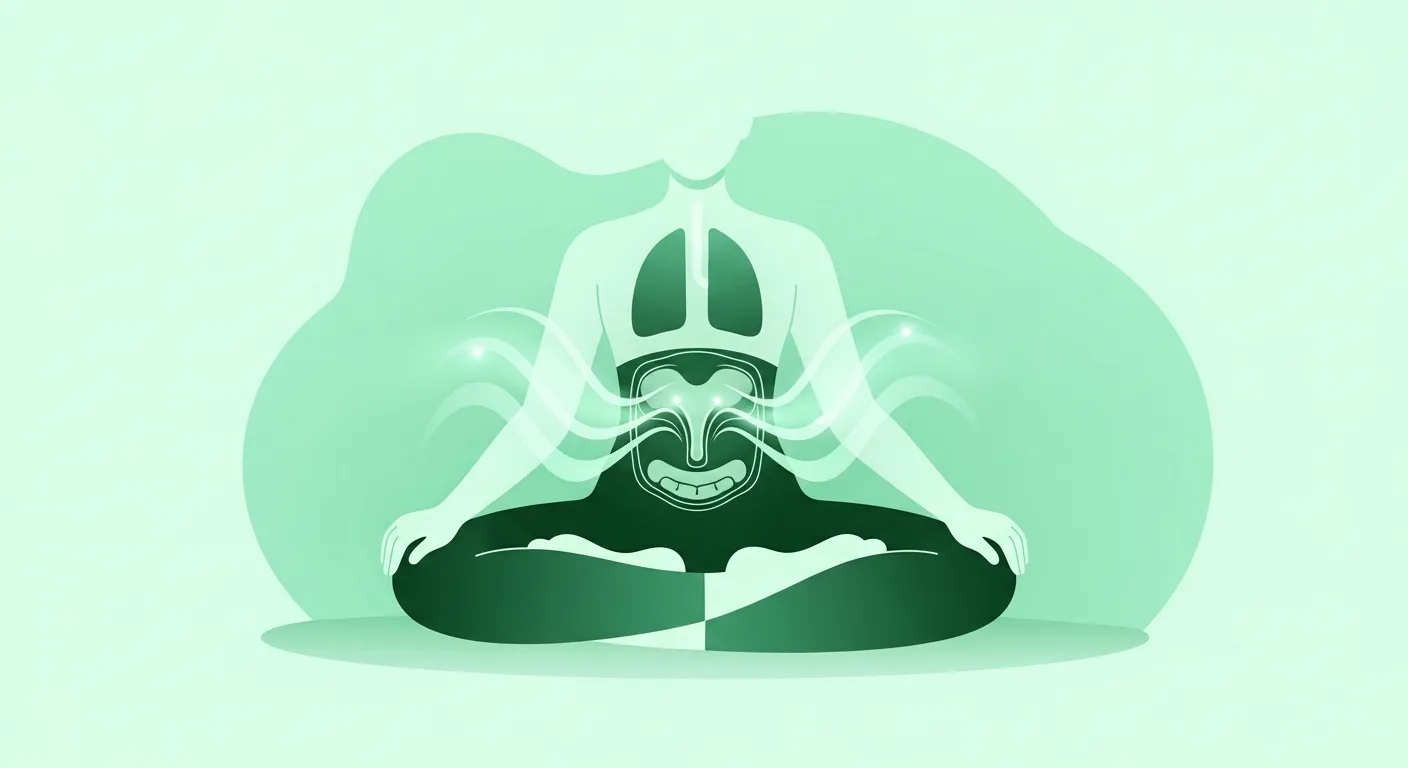
The diaphragm is a thin skeletal muscle shaped like a parachute or jellyfish, located at the base of the rib cage. It separates the thoracic cavity (lungs, heart) from the abdominal cavity (stomach, liver, intestines).
During a proper inhalation:
- The diaphragm contracts and descends, creating a vacuum in the rib cage.
- The lungs fill with air through suction — without active muscular effort.
- The abdominal organs are pushed downward, making the belly expand.
During exhalation:
- The diaphragm relaxes and rises.
- The lungs compress and expel air.
- The belly naturally flattens.
This "piston" movement is extremely efficient. It ventilates the base of the lungs well, the area with the most blood flow when standing or sitting, which favors gas exchange. Upper chest breathing, by comparison, ventilates the top of the lungs more, where blood flow is lower.
Why have you lost this breathing pattern?
Several factors contribute to the gradual loss of diaphragmatic breathing:
- Chronic stress: when facing danger (real or perceived), the body activates "fight or flight" mode, which accelerates breathing and shifts it to the upper body. If stress is constant, this chest breathing becomes the norm.
- Prolonged sitting: being seated compresses the abdominal organs and prevents the diaphragm from fully descending. 8 hours a day at a desk means 8 hours of training in poor breathing.
- Body image: the "flat stomach" culture unconsciously drives people to keep their abdomen constantly contracted, blocking the diaphragm's natural movement.
- Emotional tension: lasting anxiety or past trauma often go with high, held breathing, which eventually becomes a habit.
- Lack of movement: without regular physical activity, the diaphragm weakens like any other muscle.
Research-backed benefits of diaphragmatic breathing
Studies on diaphragmatic breathing are still few and often small, but they point in the same direction. Here is what they show:
Stress and anxiety reduction
In a trial published in Frontiers in Psychology (2017), 40 adults were randomly assigned: after 8 weeks, those practicing diaphragmatic breathing had lower salivary cortisol, less negative affect and better attention, unlike the control group (Ma et al., 2017). A systematic review confirms this trend for stress, based on only three studies (Hopper et al., 2019).
Improved digestion
The downward movement of the diaphragm literally massages the digestive organs with each breath. This movement, together with calming via the vagus nerve, which controls digestion, may explain its digestive effects. In a randomized trial, 4 weeks of abdominal breathing exercises reduced acid reflux and improved quality of life in patients with gastroesophageal reflux disease (Eherer et al., 2012). For irritable bowel syndrome, trials remain few and small.
Lower blood pressure
In people with hypertension, breathing slowly, at around 6 breaths per minute, lowers blood pressure during the session (Joseph et al., 2005). The lasting effect of daily practice is more modest: it is a useful complement, not a substitute for prescribed treatment.
Enhanced athletic performance
Athletes who master diaphragmatic breathing often breathe more fully and economically, which helps them keep control of their breath during effort and recover calmly.
Chronic pain reduction
Slow breathing activates the parasympathetic nervous system, which can ease pain perception. A systematic review found a pain-relieving effect of slow breathing in some of the studies, with no established mechanism yet (Jafari et al., 2017).
Progressive exercises: from beginner to expert
Level 1: discovery (weeks 1-2)
Exercise: lying-down breathing
- Lie on your back, knees bent, feet on the floor.
- Place one hand on your chest and the other on your belly.
- Inhale slowly through your nose for 4 seconds. Only the hand on your belly should rise. The hand on your chest doesn't move.
- Exhale through your mouth for 6 seconds. The belly goes down.
- Practice for 5 minutes, twice daily.
Tip: if your belly doesn't move, place a light book on it. Try to lift it with each inhalation. The weight provides tactile feedback that helps the brain reactivate the diaphragm.
Level 2: integration (weeks 3-4)
Exercise: seated breathing
- Sit on a chair, back straight but relaxed.
- Place your hands on your lateral ribs (below the armpits).
- Inhale through the nose: feel your ribs expand laterally (360° expansion).
- Exhale slowly: the ribs return to position.
- Practice for 5 minutes, 3 times daily (morning, noon, evening).
The goal is to learn 360-degree breathing: the diaphragm descends, the belly expands forward, the ribs spread laterally, and the lower back slightly expands backward.
Level 3: automation (month 2+)
Exercise: breathing in motion
- While walking, synchronize your breathing with your steps: inhale for 4 steps, exhale for 6 steps.
- Maintain diaphragmatic breathing (belly expanding) while walking.
- Gradually apply the same principle during jogging, cycling, or any other activity.
Common mistakes to avoid
- Forcing the belly out: belly expansion is a natural consequence of the diaphragm descending, not an active push. Don't deliberately push your belly — let it inflate naturally.
- Blocking the chest: the goal isn't to prevent all chest expansion, but to let the diaphragm initiate the movement. Slight chest expansion at the end of inhalation is normal.
- Breathing too loudly: diaphragmatic breathing is silent and gentle. If you can hear your breath, you're forcing it.
- Practicing under stress: start in a calm environment. Integration during stressful moments will come naturally once the motor pattern is established.
- Giving up too soon: the diaphragm is a muscle. Like any muscle, it needs time to strengthen. Allow 3-4 weeks before diaphragmatic breathing becomes automatic.
When to practice
Ideally, integrate diaphragmatic breathing into key moments of your day:
- Upon waking: 5 minutes of diaphragmatic breathing before getting up activates the parasympathetic nervous system and prepares your body for the day.
- Before meals: 2 minutes of diaphragmatic breathing activates the vagus nerve and prepares the digestive system.
- During stressful situations: a difficult meeting, traffic jam, conflict — a few slow, deep breaths help bring the tension down.
- Before bed: 5-10 minutes of diaphragmatic breathing helps calm body and mind before sleep.
Conclusion
Diaphragmatic breathing isn't an exotic technique — it's the way your body is designed to breathe. Relearning it means returning to fundamentals. With 10 minutes of daily practice, you can manage stress better and, according to early trials, ease some digestive complaints and lower your blood pressure during practice. The BreathLife app guides you through every step with exercises adapted to your level and progress tracking.
It is especially valuable during pregnancy, for teaching children to breathe well, and for understanding CO₂'s role in respiratory efficiency.