
Introduction: why teach children to breathe?
Children experience intense emotions — anger, frustration, excitement, fear — but have few tools to regulate them. Conscious breathing is one of the simplest ways to teach them to calm down, focus, and sleep better. A meta-analysis of 33 randomized trials (Dunning et al., 2019, Journal of Child Psychology and Psychiatry) indicates that mindfulness programs — which rely heavily on attention to the breath — modestly reduce anxiety and stress in children and adolescents, with clearer effects on attention compared with no intervention.
The key: make it fun. A child won't sit in lotus position to "meditate." But they'll enthusiastically blow a pinwheel, do dragon breathing, or count breaths like a superhero. Here's a practical age-by-age guide.
Ages 3-5: play first
At this age, everything happens through play and imagination. Exercises should be short (1-2 minutes) and visual.
Balloon breathing
Ask the child to place their hands on their belly. "Your tummy is a balloon. We're going to slowly inflate it by breathing in through the nose... and slowly deflate it by blowing out through the mouth." Do it together, 3-5 times.
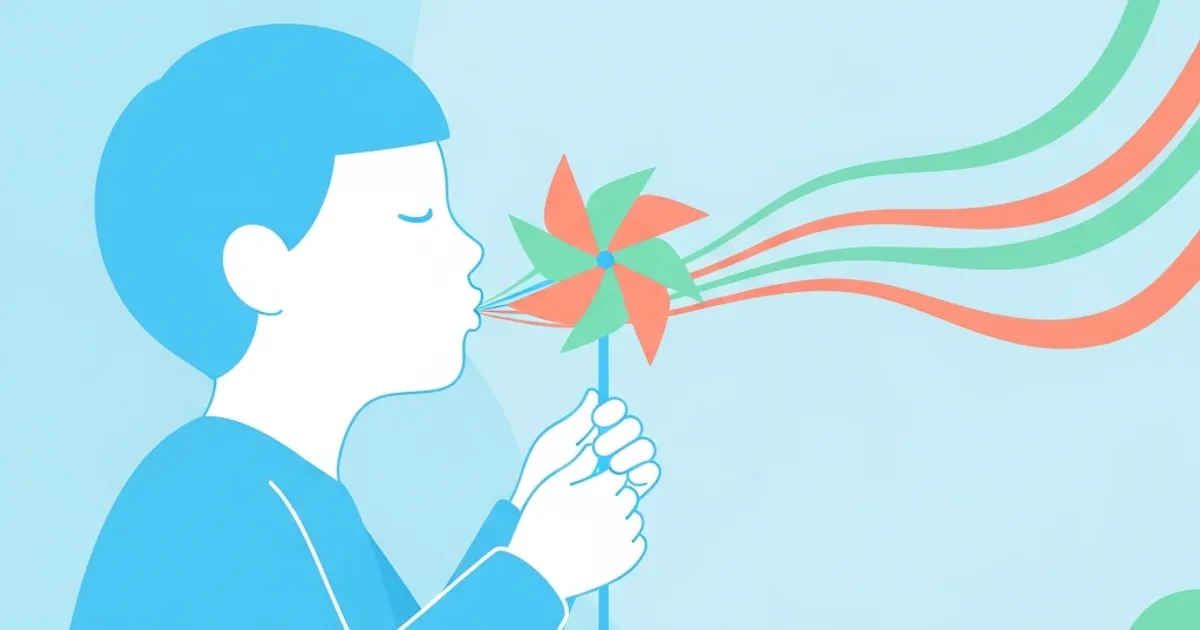
The magic pinwheel
Use a real pinwheel (or paper windmill). The child must blow gently enough to make it spin slowly, not hard enough to spin it at full speed. This naturally forces them to lengthen their exhale — the main calming mechanism.
Bee breathing
Inhale together through the nose, then exhale making "bzzzzz" like a bee. The extended humming lengthens the exhale, and many children find the vibration soothing. It's a child-friendly version of "Bhramari Pranayama" used in yoga.
Ages 6-8: structured exercises
At this age, children can follow more precise instructions and understand the "whys."
Superhero breathing
"Superheroes breathe for calm super-strength." Standing, fists on hips. Inhale 3 seconds while growing tall (on tiptoes), exhale 4 seconds while coming back down. 5 repetitions. This combines movement and breathing, ideal for restless children.
Star hand
The child spreads the fingers of one hand. With the index finger of the other hand, they trace the outline of each finger: going up, they inhale; going down, they exhale. 5 fingers = 5 complete breaths. It's a tactile and visual exercise that helps concentration.
Hot breath / cold breath
Inhale through the nose (cold air enters). Exhale through the wide-open mouth onto the hand — feel the warmth? "That's your body warming you up." This helps the child become aware of their breathing and the difference between inhaling and exhaling.
Ages 9-12: toward breathing autonomy
Pre-teens can start using simplified "adult" techniques.
Box breathing
Inhale 4 seconds, hold 4 seconds, exhale 4 seconds, wait 4 seconds. Repeat 4 times. Tell them it's a special forces technique — that motivates them! (It's true, by the way — this "box breathing" was popularized by former Navy SEALs.)
Test-day breathing
Before a test or stressful situation: 3 big inhales through the nose, 3 long exhales through the mouth. Then 1 minute of normal breathing focusing on the feeling of feet on the floor. Simple, discreet, effective.
Breathing journal
Encourage the child to note their mood before and after breathing exercises (with emojis or drawings for younger ones). This helps them connect practice to effects — and develop the habit naturally.
Practical situations
Calming anger
Don't say "calm down" (it never works). Say: "Let's blow together, like we're blowing out birthday cake candles. Blow hard! One more! And one last one, very gently." Three strong exhales, then a gentle one — the transition is natural.
Helping with sleep
At bedtime, do "sleepy breathing": lying down, a stuffed animal on the belly, the child must make the toy rise and fall with their breathing, as slowly as possible. It's relaxing and fun — much more effective than "close your eyes and sleep." For more sleep breathing techniques, see our dedicated guide.
Before a show or competition
"Lion breathing": big inhale, then stick out the tongue, open eyes wide, and exhale making "HAAA!" It makes them laugh, relaxes facial muscles, and releases tension. Perfect backstage or in the locker room.
Mistakes to avoid
- Forcing it: a child who doesn't want to breathe shouldn't be forced. Suggest, lead by example, but never turn breathing into punishment.
- Too long: keep sessions short (2-5 minutes maximum). Consistency matters more than duration.
- Too serious: if it's not fun, it won't work. Laugh together, make silly sounds, invent stories.
- Only using breathing in crisis: practice when everything is fine too, so the child doesn't associate it only with negative moments.
Conclusion
Teaching children to breathe is giving them a tool they'll use their entire lives. No equipment needed, no special skills: just your presence, a bit of creativity, and the willingness to practice together. Start tonight with sleepy breathing — and watch the magic happen.