
Key takeaways
The physiological sigh is a double inhale through the nose (one full breath, then a short top-up) followed by a long exhale through the mouth. Your body already does it on its own, roughly once every five minutes, to reinflate the air sacs in the lungs that have quietly collapsed. Done on purpose, it is the best-documented answer to "what is the fastest way to calm down": one to three sighs, ten to thirty seconds, are enough to bring heart rate down. Repeated for five minutes, it becomes cyclic sighing, the protocol that came out on top in a randomized trial at Stanford.
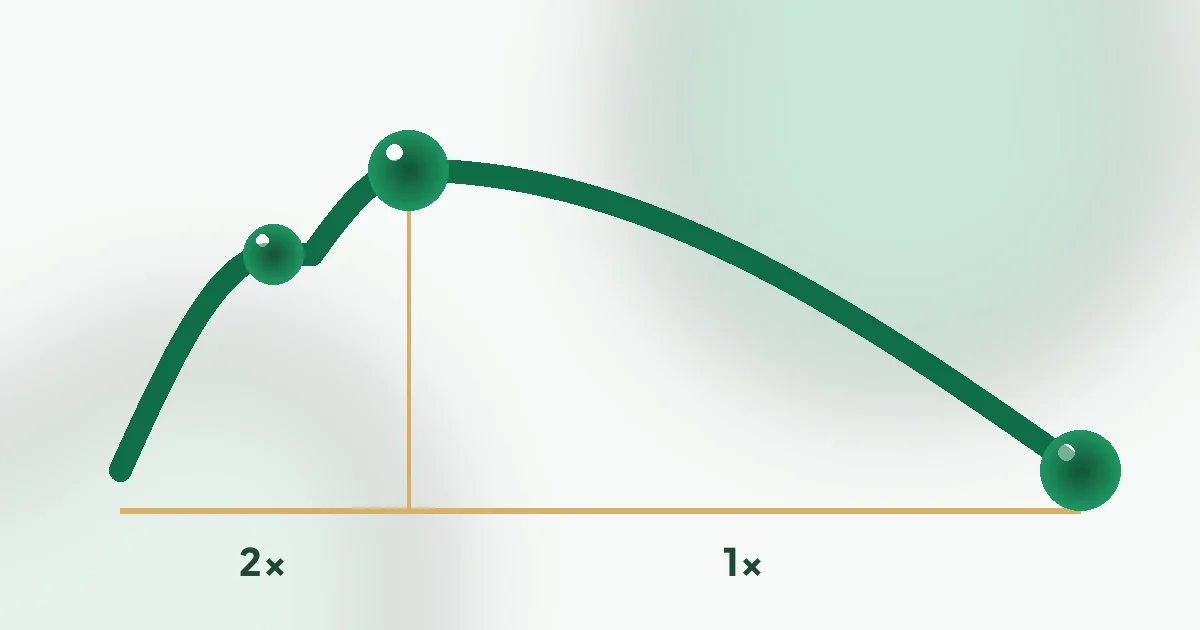
- One sigh takes about 10 seconds: a 2 to 3-second first inhale, a 1-second second inhale, a 6 to 8-second exhale.
- The reflex is driven by roughly 200 neurons in the brainstem, mapped in 2016 by Jack Feldman's team (Li et al., Nature).
- A resting adult sighs spontaneously about a dozen times an hour; without sighs, alveoli gradually stick together and gas exchange degrades.
- In the Stanford trial (Balban et al., 2023), 5 minutes a day of cyclic sighing for one month improved mood and lowered breathing rate more than mindfulness meditation, box breathing or cyclic hyperventilation.
- Two doses to remember: 1 to 3 sighs for an emergency, 5 minutes a day as a baseline practice.
What is the physiological sigh?
A sigh is not just a sign of weariness. In every mammal it is a vital respiratory reflex: an inhale about twice the normal volume, often taken in two steps, followed by a long exhale. Physiologists call it the "physiological sigh" to set it apart from the emotional sigh of everyday speech, although the two overlap more often than not. Its first job is mechanical. The alveoli, the hundreds of millions of tiny sacs where blood swaps oxygen for carbon dioxide, tend to collapse during quiet, regular breathing. A sigh pops them open all at once, the way you shake out a plastic bag to open it.
The term left the lab in 2020, when Stanford neuroscientist Andrew Huberman presented it as the fastest known way to calm down in real time, hence the searches for the "Huberman breathing technique." The technique belongs to no one: it copies a move you already make without thinking, on waking up, after crying, at the end of a tense meeting.
How it differs from neighboring techniques
- Versus extended exhale breathing (4-8): both rely on a long exhale, but the sigh adds the double inhale, which reopens the alveoli and gives accumulated CO₂ more surface area to leave through. That is what makes it faster on a stress spike.
- Versus yawning: both are brainstem reflexes, but a yawn is a slow, open-mouthed inhale tied to alertness and brain temperature, not a reinflation maneuver.
- Versus an ordinary "big sigh": the difference is the second, short inhale taken without exhaling in between. Without it, the effect on the alveoli is smaller.
Emergency sigh and cyclic sighing: two different uses
The first use is situational: 1 to 3 sighs, ten to thirty seconds, when you need to come down right now. The second is a practice: 5 minutes of back-to-back sighs, every day, to lower your baseline arousal over time. One replaces the exercise you have no time for, the other replaces a meditation session.
How to do the physiological sigh, step by step
- Take a neutral position. Sitting or standing, shoulders loose, eyes open: the technique is designed to be used in the middle of a situation.
- First inhale through the nose. Full but unforced, for 2 to 3 seconds, letting the belly and then the chest fill.
- Second inhale, short. Without exhaling, add a small one-second sniff through the nose to top up the lungs. You will feel the rib cage open a little further. This is the step that does the work.
- Long exhale through the mouth. Lips slightly parted, let the air leave slowly and completely, for 6 to 8 seconds, all the way out without pushing. Let the shoulders and jaw drop with it.
- Breathe normally for a few seconds. Notice it: the heart slows, the shoulders come down.
- Repeat once or twice if needed. One to three sighs are enough in the moment. Beyond that, switch to the cyclic version or to a standard extended exhale.
Common mistakes
- Skipping the second inhale, or exhaling between the two. The double inhale is continuous, with no air going out.
- Making the second inhale as big as the first. It is a top-up, not a doubling. If it feels forced, it is too big.
- Dumping the exhale. A short, loud exhale feels good for an instant but does not engage the vagal brake. The calming effect comes from the length of the exhale.
The 5-minute version: cyclic sighing
In the protocol studied at Stanford, cyclic sighing means repeating physiological sighs back to back, with no normal breaths between them, for 5 minutes, with the emphasis on a slow, complete exhale, once a day. It is not an emergency tool but a daily hygiene, in the same category as a coherent breathing session.
Rhythms for every level
BreathLife does not yet offer a guided "sigh" exercise. The table below is therefore an indicative protocol for cyclic practice, built on the same logic as the app's exercises: the higher your CO₂ tolerance, the longer the exhale and the session can be. For the emergency use, the dose does not change with level: 1 to 3 sighs.
| Level | Inhale 1 + 2 | Exhale | Cycles | Approx. duration |
|---|---|---|---|---|
| Strained | 2 s + 1 s | 6 s | 18 | 3 min |
| Tired | 2 s + 1 s | 8 s | 16 | 3 min |
| Optimal | 3 s + 1 s | 8 s | 20 | 4 min |
| Efficient | 3 s + 1 s | 10 s | 21 | 5 min |
| Exceptional | 3 s + 1 s | 12 s | 19 | 5 min |
There are no holds in this protocol. If a 6-second exhale already leaves you hungry for air, shorten it to 4 or 5 seconds: the ratio matters more than the absolute length.
How to choose your level
The right level is the one where the exhale stays comfortable through its final second, with no urge to grab air early. To measure it, BreathLife uses the breathing age test: after a normal exhale, you hold your breath and time it until the first clear urge to breathe, capped at 60 seconds. That time reflects your CO₂ tolerance. As a guide: under 10 s is Strained, 10 to 15 s Tired, 15 to 20 s Optimal, 20 to 25 s Efficient, and over 25 s Exceptional; the exact cutoffs shift with age.
Benefits and what the science says
1. The double inhale reopens the alveoli
When breathing stays quiet and shallow for a few minutes, some alveoli empty out and their walls stick together (partial atelectasis). Fewer open alveoli means less surface to offload CO₂, and rising CO₂ is an alarm signal for the brain. Thanks to its larger volume, a sigh peels those alveoli apart again. Jan-Marino Ramirez (2014) describes this function in a landmark review and notes that too few sighs are seen in several respiratory disorders, while too many accompany anxiety and panic: the sigh is a regulator in both directions.
2. The long exhale brakes the heart through the vagus nerve
During the exhale, the vagus nerve regains control of the heart and slows it; during the inhale, it eases off the brake. A slow 6 to 12-second exhale from well-filled lungs gives it time to act. It is the mechanism of extended exhale breathing, applied here to reinflated lungs, so with a bigger outflow of air and a calming effect that usually arrives faster.
3. A sigh generator in the brainstem
In 2016, the teams of Jack Feldman (UCLA) and Mark Krasnow (Stanford) described in Nature the circuit that triggers sighs in mice: about 200 brainstem neurons, next to the breathing rhythm generator, release two neuropeptides that command a double-sized inhale. Blocking those signals abolishes sighing; stimulating them multiplies it. The sigh is therefore a hardwired reflex, present in every mammal, roughly once every five minutes in resting humans. Sighing on purpose means borrowing a circuit that is already in place.
4. A breathing "reset" and a feeling of relief
Elke Vlemincx's group (KU Leuven) observed that breathing becomes abnormally regular or abnormally erratic just before a spontaneous sigh and returns to normal variability right after: the "resetter" hypothesis (2010), the sigh resetting the breathing rhythm. In a second study (2016), sighs, both spontaneous and instructed, were accompanied by self-reported relief and physiological signs of relaxation. Studies therefore suggest that the sigh is both a recalibration of breathing and a release signal for the brain.
5. The Stanford randomized trial
The strongest study to date is by Melis Yilmaz Balban, David Spiegel and Andrew Huberman (Cell Reports Medicine, 2023). A little over a hundred adults were randomly assigned to four groups, each practicing 5 minutes a day for one month: mindfulness meditation, cyclic sighing, box breathing, or cyclic hyperventilation with retention. All three breathing groups improved more than the meditation group on positive affect, and the cyclic sighing group showed the largest mood improvement and the largest drop in resting respiratory rate. Anxiety fell in every group, with no clear difference between them. The effect grew with the number of days practiced, which argues for consistency. Limits flagged by the authors: a remote study, self-reported mood, a single month.
The founder of BreathLife practiced this technique himself in October 2026, during a three-day workshop in Vienna with breathwork teacher Dan Brulé, where the physiological sigh was presented as the basic nervous-system regulation tool before moving on to more intense practices.
When to use it, when to avoid it
Good moments
- Thirty seconds before public speaking, an interview or a hard phone call: two discreet sighs, mouth barely open, while you wait your turn.
- At the peak of anger or frustration, before you answer. One sigh buys the ten seconds that change the answer.
- After an adrenaline spike: a hard brake in traffic, bad news, an argument. The heart comes down faster than if you just wait.
- In the middle of a tense day, as a micro-break between tasks. For a fuller strategy, see our guide to breathing for stress management.
- Every day, 5 minutes of cyclic sighing, if you want a background effect on mood and baseline arousal.
When to skip it or adapt it
The physiological sigh is very well tolerated. If you feel lightheaded or tingly during the cyclic version, you are probably exhaling too hard or too fast: slow down, or return to natural breathing. Avoid long series right before an explosive effort, since the sigh is calming by nature, and do not do the 5-minute version while driving. If you already sigh very often without meaning to, with a feeling that you can never get a satisfying breath, talk to a professional: it can be the sign of an anxious breathing pattern.
BreathLife is not a medical device. If you have a respiratory or heart condition, are pregnant, or have epilepsy, ask your doctor before changing how you breathe.
How it compares with similar techniques
| Technique | Rhythm | Dominant effect | Best moment |
|---|---|---|---|
| Physiological sigh | Double nasal inhale, 6 to 12-second mouth exhale; 1 to 3 times, or 5 min cyclic | Immediate come-down, alveolar reinflation | In the moment, within 30 seconds |
| Extended exhale ("Let Go") | 4-8, 1:2 ratio, 10 cycles | Continuous vagal braking | After a stress spike, at night |
| Box breathing ("Instant Calm") | 4-4-4-4, two holds | Focus, composure | Before a task that demands precision |
| Coherent breathing ("Steady Heart") | 5-5, 1:1 ratio, 5 min | Background HRV regulation | Three times a day, preventively |
A simple rule: the sigh for the next ten seconds, the extended exhale for the next two minutes, coherent breathing for the day.
How BreathLife guides this exercise
There is no "physiological sigh" exercise in the BreathLife app yet. The closest exercise is "Let Go," an extended exhale at a 1:2 ratio whose rhythm adapts to your measured level, from 4-8 to 12-24: do two or three sighs on your own, then start a 3, 5 or 10-minute session to extend the effect of the long exhale with the guided voice. If you then want to steady your heart rate, follow up with "Steady Heart," the coherent breathing exercise. Every session counts toward your daily streak.
Conclusion
The physiological sigh is the shortest technique in the whole breathing repertoire, and probably the fastest-acting: two inhales through the nose, one long exhale through the mouth, ten seconds. It rides on a reflex your brainstem already fires every five minutes, and the Stanford trial suggests that five minutes of daily practice does more for mood than a meditation of the same length. Start with the emergency version today, and to find out how far to stretch your exhale in the cyclic version, take the free breathing age test: 60 seconds is all it takes.