
Key takeaways
Breathing exercises are deliberate ways of controlling the pace, depth, and route (nose or mouth) of your breath to influence the nervous system. Slowing down to about 6 breaths per minute, lengthening the exhale, or holding the breath briefly changes heart rate, blood pressure, and alertness within minutes. There are dozens of variations, but ten breathing techniques cover nearly every need: calming down, falling asleep, focusing, waking up, or coping with physical effort.
- Slow breathing at 4 to 6 breaths per minute increases heart rate variability and vagal activity (Russo et al., 2017; Zaccaro et al., 2018).
- A meta-analysis of 26 randomized controlled trials (Fincham et al., 2023) found a moderate effect of breathwork on perceived stress, anxiety, and depressive symptoms.
- Five minutes a day is enough to measure an effect: in Balban et al. (2023), one month of daily 5-minute breathing exercises improved mood more than an equal dose of mindfulness meditation.
- The best breathing exercise depends on the goal: long exhales to calm down, equal rhythms to balance, fast breathing to energize.
- The right pace depends on your CO₂ tolerance, which a 60-second breath-hold test can estimate.
Which exercise for which need: each row links to a detailed guide.
| Need | Exercise | Base rhythm | Guide |
|---|---|---|---|
| Acute stress, before a meeting | Box breathing | 4-4-4-4, 6 cycles | Box breathing |
| Falling asleep | 4-7-8 breathing | 4-7-8, 6 cycles | 4-7-8 for sleep |
| Daily balance, blood pressure | Coherent breathing | 5-5, i.e. 6 breaths per minute | Cardiac coherence |
| Unwinding after a long day | Extended exhale | 4-8, 10 cycles | 4-8 breathing |
| Relearning to breathe with the belly | Diaphragmatic breathing | 4-8, 10 cycles | Belly breathing |
| Focus and mental clarity | Alternate nostril breathing | 4-8 per nostril, 10 cycles | Nadi Shodhana |
| Waking up, getting energy | Kapalabhati | 45 breaths, 1 round | Breath of fire |
| CO₂ tolerance, sports, freediving | Gentle Hold, Athlete's Breath | 4-4-4-8 / 4-4-8 | Breath-hold training |
| Simple grounding for beginners | Triangle breathing | 4-4-4, 8 cycles | Triangle breathing |
How breathing exercises work on the body
Breathing is the only vital function that is both automatic and voluntary. You cannot command your digestion, but you can slow your breath at will. That is the doorway through which breathing exercises reach the autonomic nervous system, which has two branches: the sympathetic branch mobilizes (faster heart rate, alertness, muscle tension) and the parasympathetic branch restores (slower heart rate, digestion, recovery). With every inhale, the heart speeds up slightly; with every exhale, it slows down. Lengthening the exhale therefore means spending more time under parasympathetic control, which is why nearly every calming technique shares an exhale longer than the inhale.
The second lever is carbon dioxide. Contrary to popular belief, the urge to breathe is not triggered by a lack of oxygen but by rising CO₂ in the blood, detected by chemoreceptors. When you breathe faster or deeper than your body needs, you blow off too much CO₂: blood vessels constrict, hemoglobin releases oxygen to the tissues less readily (the Bohr effect), and you get tingling, lightheadedness, and the paradoxical feeling of being short of air. Slow nasal breathing or a brief hold brings CO₂ back toward normal and, with training, pushes back the threshold at which the body sounds the alarm (see our article on CO₂).
The third lever connects the first two: the vagus nerve, the main parasympathetic pathway, and heart rate variability (HRV), a measure of how flexibly the heart adjusts its rhythm. At around 6 breaths per minute, the oscillations of breathing, blood pressure, and heart rate fall into resonance, and HRV reaches its maximum amplitude (Lehrer and Gevirtz, 2014). The review by Russo, Santarelli, and O'Rourke (2017) reports that voluntary slow breathing raises HRV, improves baroreflex sensitivity, and lowers blood pressure in healthy adults, and the systematic review by Zaccaro et al. (2018) links it to increased EEG alpha power and lower self-reported anxiety and anger. The vagus nerve is the common thread running through these effects.
The 10 breathing exercises, one by one
For each technique: the common name, the name used in the BreathLife app, the base rhythm, and the range across levels from the most accessible to the most demanding.
1. Box breathing — "Instant Calm"
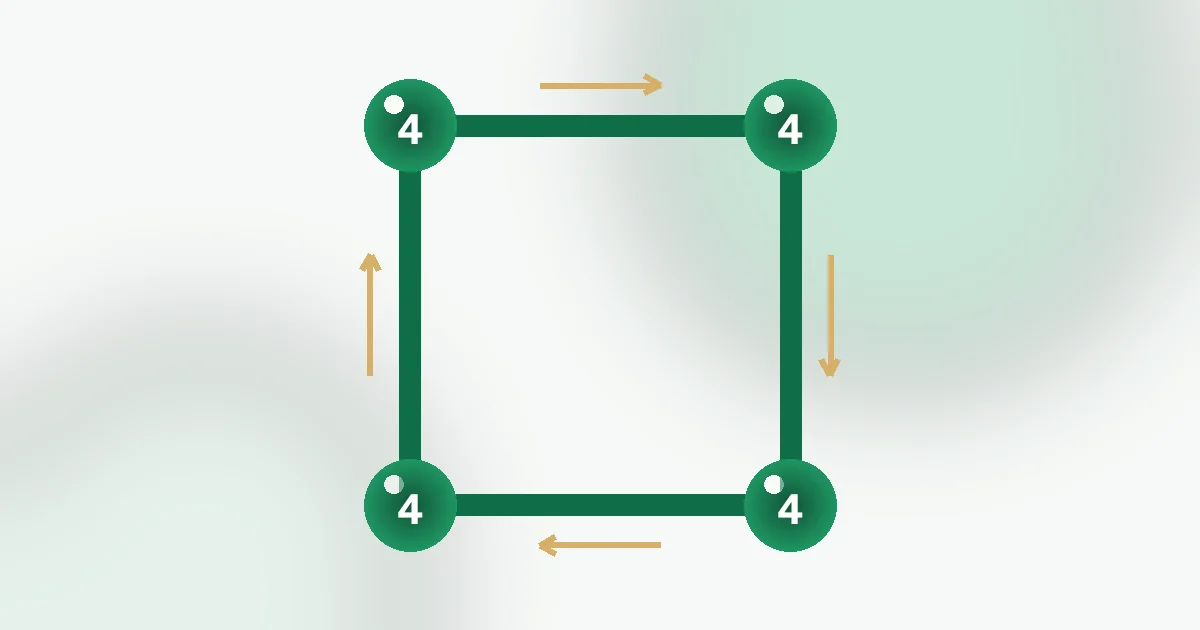
Inhale for 4 seconds, hold for 4, exhale for 4, stay empty for 4. Six cycles are enough for a first session. In BreathLife the rhythm runs from 4-4-4-4 at the Strained level to 11-11-11-11 at the Exceptional level. The two pauses set a tempo for the mind and give it something to count, which interrupts rumination. It is the go-to exercise before an interview, a presentation, or during a stress spike. Full guide: the 4-4-4-4 box breathing technique.
2. Triangle breathing — "Grounding"
Same idea as the box without the empty hold: inhale 4, hold 4, exhale 4, repeat. Eight cycles at the base rhythm, from 4-4-4 to 10-10-10 depending on your level. Skipping the empty pause makes it easier for beginners, for anyone who gets nervous at the thought of "running out of air," and for children. Guide: triangle breathing.
3. Coherent breathing (cardiac coherence) — "Steady Heart"
Inhale and exhale for equal lengths, usually 5 seconds each, which gives 6 breaths per minute. This is the resonance rhythm described above and the most studied technique on this list. The classic "3-6-5" protocol (3 times a day, 6 breaths per minute, 5 minutes) works for almost everyone. BreathLife adjusts the pace from 4-4 to 14-14 by level over 10 cycles; from the Optimal level (6-6) onward you drop below 6 breaths per minute. Guide: cardiac coherence, the complete guide.
4. Diaphragmatic breathing — "Deep Reset"
Place a hand on your belly, inhale through the nose and let the abdomen rise, then exhale twice as long while it falls: 4-8 at the base rhythm, up to 12-24 at higher levels, over 10 cycles. This is not one technique among others; it is the foundation for all of them. If the diaphragm is not doing the work, every other exercise stays shallow. Make it your priority if you breathe "high" with lifted shoulders. Guide: diaphragmatic breathing.
5. Extended exhale 4-8 — "Let Go"
Inhale for 4 seconds, exhale for 8, no hold, for 10 cycles; the range runs from 4-8 to 12-24. The 1:2 ratio is the simplest of the calming rhythms and the most forgiving: no pause, no complicated count, just a slow exhale through the nose or pursed lips. In Balban et al. (2023), the long-exhale variant ("cyclic sighing") produced the largest improvement in mood. Ideal in the evening, when you get home, or between two meetings. Guide: extended exhale breathing.
6. 4-7-8 breathing — "Deep Sleep"
Inhale for 4 seconds through the nose, hold for 7, exhale for 8 through the mouth, 6 cycles. Popularized by Dr. Andrew Weil, this sequence combines a full-lung hold with a very long exhale, which makes it the most sedating exercise on the list. BreathLife starts at 3-5-6 and goes up to 10-13-14. Save it for bedtime or nighttime awakenings, lying down with the lights off. Guide: the 4-7-8 technique for sleep.
7. Alternate nostril breathing (Nadi Shodhana) — "Clear Mind"
Close the right nostril with your thumb and inhale on the left for 4 seconds; close the left and exhale on the right for 8; inhale on the right, exhale on the left. One cycle covers both sides; do 10 cycles, from 3-6 to 12-24 by level. Borrowed from pranayama, this technique demands attention (switching fingers, following the airflow), and that is exactly what makes it effective for clearing the mind before focused work. Guide: alternate nostril breathing.
8. Athlete's Breath (alternate nostril with a 1:1:2 hold)
Same hand position as alternate nostril breathing, with a full-lung hold between the inhale and the exhale: 4-4-8 at the base rhythm, from 3-3-6 to 12-12-24, 10 cycles. The full hold adds a controlled dose of CO₂ and sharpens concentration. It is the variant we recommend to athletes who want to train calm and effort tolerance at the same time.
9. Gentle Hold (box with a doubled empty hold)
Inhale 4, hold 4, exhale 4, then stay empty for 8: the empty pause lasts twice the inhale. Six cycles, from 4-4-4-6 to 7-7-7-14. The empty-lung hold is the most direct way to train CO₂ tolerance, the very thing the breathing age test measures, so this is the exercise that moves you from one level to the next. It requires staying relaxed and never forcing: the pause ends at the first clear urge to breathe. Guide: breath-hold training and CO₂ tolerance.
10. Kapalabhati (breath of fire) — "Energy Boost"
The only energizing exercise on the list. Exhale through the nose in short, active contractions of the belly, about one breath per second, and let the inhale happen on its own between exhales. Count 45 breaths at the base rhythm, from 35 to 200 by level, in a single round. Kapalabhati wakes you up, clears the head, and warms the body; it is an alternative to a second coffee and a good lead-in to a workout. It is not suited to the evening (see precautions). Guide: Kapalabhati, the breath of fire.
How to choose your exercise and progress
Choose by need. Ask yourself one question: do you want to come down or go up? To come down (stress, restlessness, falling asleep), pick a long-exhale or slow equal-rhythm exercise: extended exhale, coherent breathing, 4-7-8. To go up (fatigue, brain fog), choose Kapalabhati, or alternate nostril breathing if you want focus more than energy. For acute stress, box breathing. If in doubt, start with coherent breathing: it is the safest and best-documented compromise.
Choose the pace with the breathing age test. Every exercise above comes in five versions, because a rhythm that feels comfortable to a trained practitioner can be a struggle for a beginner, and vice versa. The breathing age test settles the question in 60 seconds: after a normal exhale, hold your breath until the first clear urge to breathe. Under 10 seconds is Strained; 10 to 15 is Tired; 15 to 20 is Optimal; 20 to 25 is Efficient; above 25 is Exceptional. These thresholds are indicative and shift with age, as explained in our article on respiratory age. Your level then sets the rhythm for every exercise: box breathing is 4-4-4-4 at Strained, 7-7-7-7 at Optimal, and 11-11-11-11 at Exceptional.
Choose the duration. Three minutes is enough for an immediate effect in a specific situation. Five minutes is the reference daily dose, the one used in the 3-6-5 protocol and in Balban et al. (2023). Ten minutes suits evening sessions or days when you have the time. The rule that matters: a short daily session beats a long weekly one. The adaptations are built by repetition, not intensity.
Progress. When a rhythm becomes comfortable, meaning you finish the session without effort, mouth closed, without speeding up on the last cycles, move up one level. Retake the test about once a month. To structure the first four weeks, BreathLife offers a 28-day program that rotates through the exercise families, introduces holds gradually, and protects your streak with a free pass if you miss a day.
Common mistakes
- Breathing through the mouth. Unless a technique calls for a specific exhale (4-7-8, pursed lips), always inhale through the nose: the air is filtered, warmed, and enriched with nitric oxide, and the lower flow rate prevents overbreathing. Our article on nasal vs. mouth breathing explains why.
- Forcing. A hold that makes you grimace, an exhale that ends with you squeezing your ribs, an inhale that lifts your shoulders: all of these activate the sympathetic branch, the opposite of the goal. If a rhythm is a struggle, drop down one level.
- Overbreathing. "Breathing deeply" does not mean breathing a lot. Moving too much air during a slow exercise drives CO₂ down and causes dizziness and tingling. Your breathing should stay quiet and almost invisible.
- Lying down when you should be sitting. Lying flat changes the mechanics of the diaphragm and tips the nervous system toward drowsiness. Perfect for 4-7-8 at bedtime, counterproductive for coherent breathing, alternate nostril breathing, or Kapalabhati, which are done seated with a straight back.
- Comparing yourself. A 12-second hold is not a failure; it is a starting point. Higher rhythms are not "better," they simply match a different CO₂ tolerance. The only useful comparison is your own test, month over month.
Precautions
Slow exercises with equal rhythms or long exhales (coherent breathing, diaphragmatic breathing, extended exhale, triangle) have no known risk for a healthy person and can be practiced daily. Exercises with holds (box, Gentle Hold, 4-7-8, Athlete's Breath) call for more care: never practice them in water, while driving, or standing if you are prone to dizziness, and stop at the first clear urge to breathe. Kapalabhati is not recommended during pregnancy or for people with uncontrolled high blood pressure, heart disease, epilepsy, glaucoma, a hernia, or recent abdominal surgery. If an exercise triggers chest tightness, palpitations, or rising anxiety, return to natural breathing and choose a gentler technique. BreathLife is not a medical device; if you have a respiratory or heart condition, are pregnant, or have epilepsy, ask your doctor before starting.
In BreathLife
The ten exercises in this guide are the ten exercises in the BreathLife app: Instant Calm, Grounding, Steady Heart, Deep Reset, Let Go, Deep Sleep, Clear Mind, Athlete's Breath, Gentle Hold, and Energy Boost. The built-in breathing age test sets your level, and every exercise starts at the matching rhythm, in 3, 5, or 10 minutes, with guided voice in English or French. The daily streak and its free pass keep you consistent, the 28-day program structures your first month, and a group session brings practitioners together every Sunday at 8 p.m.
Conclusion
There is no single best breathing exercise, only the best exercise for a given need, level, and moment. For most people, the safest path has three steps: learn to breathe through the nose and with the belly, build a daily five-minute habit of coherent breathing or extended exhales, then add holds and specialized techniques over the following weeks, for sleep, focus, or energy. To find out where to start, take the free breathing age test: 60 seconds, no equipment, and a starting level for each of the ten exercises.