
Key takeaways
Triangle breathing, also called 4-4-4 breathing, is a three-count breathing exercise: inhale through the nose for 4 seconds, hold with full lungs for 4 seconds, then exhale for 4 seconds. There is no pause with empty lungs. It is the simpler cousin of box breathing: a slow rhythm (about 5 breaths per minute) that settles the nervous system and brings your attention back to the present without making you drowsy.
- Three equal counts: inhale, hold with full lungs, exhale. No empty-lung hold.
- 12 seconds per cycle at 4-4-4, which is 5 breaths per minute, well inside the slow-breathing range studied in the lab (under 10 breaths per minute).
- 8 cycles make a complete first session: under 2 minutes.
- Easier than box breathing: holding with full lungs feels natural; the empty-lung hold is what makes beginners and kids uncomfortable.
- 5 levels in BreathLife, from 4-4-4 to 10-10-10, chosen from your breathing age test.
What is triangle breathing?
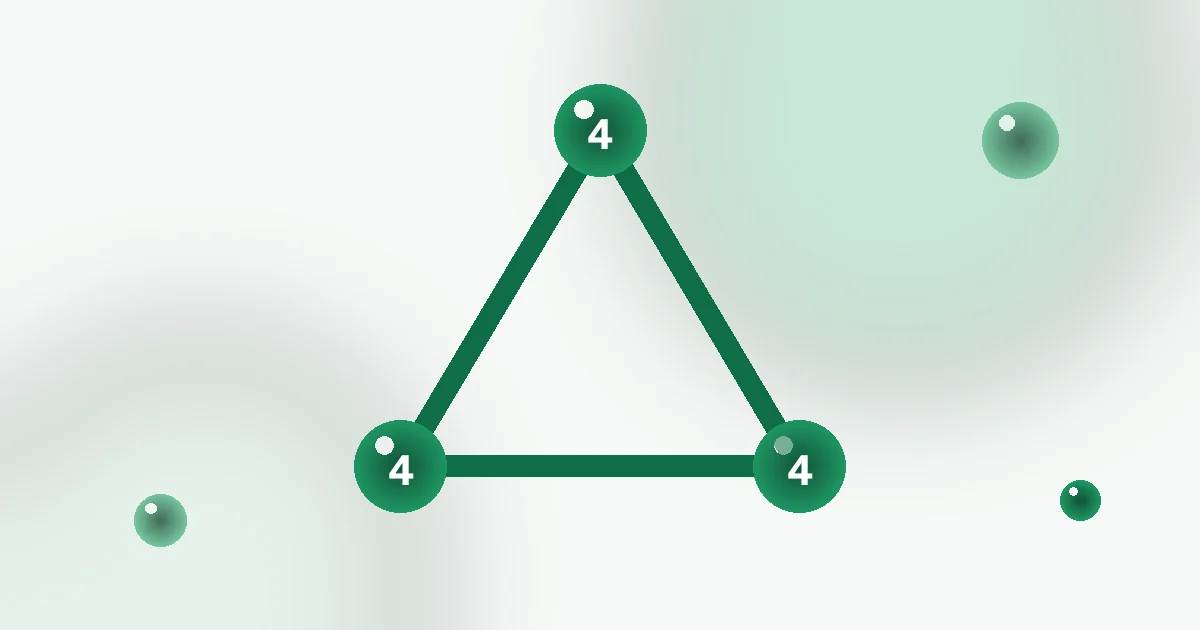
Triangular breathing belongs to the family of paced breathing techniques, where every phase of the breath is counted. The name comes from the image used to guide it: you trace the three sides of a triangle in your mind or with a finger. The first side rises with the inhale, the second runs flat during the hold, the third comes down with the exhale. Then you start again from the first corner.
The image is not a gimmick. Counting and visualizing keep the mind busy, which interrupts rumination. That is what makes this a grounding breathing exercise: a technique that pulls attention back to a bodily sensation, here the breath, to break out of a loop of anxious thoughts. This is also why teachers and speech therapists use triangle breathing for kids so often; children draw the triangle on paper or in the air while they breathe.
Triangle vs. box: the difference
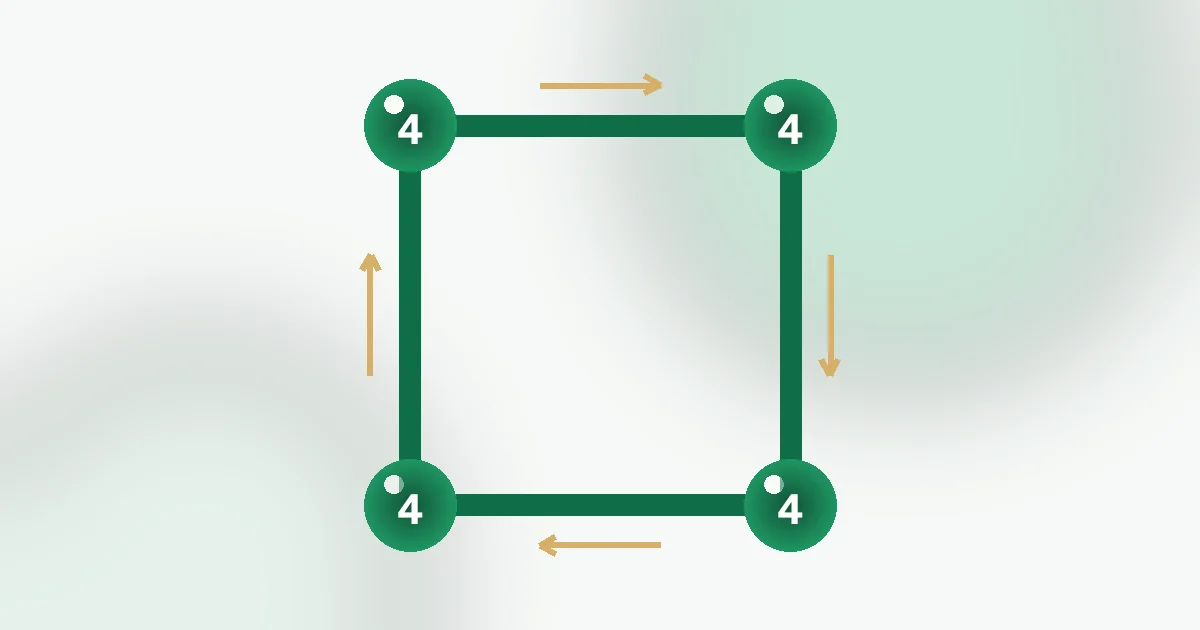
Box breathing adds a fourth side: a 4-second hold with empty lungs after the exhale. That empty hold is the hard part of the box. With empty lungs, carbon dioxide (CO₂) rises quickly in the blood and the urge to breathe becomes insistent. With full lungs, by contrast, your oxygen reserve is at its peak and the hold stays comfortable for several seconds.
Triangle breathing keeps what matters in the box, a slow rhythm and counted phases, and drops the one step that can tense up a beginner. It also differs from cardiac coherence, which has no hold at all, and from 4-8 breathing, which lengthens the exhale to push toward deep relaxation. The triangle stays symmetrical: it calms you without putting you to sleep.
How to do 4-4-4 breathing, step by step
- Sit down with a straight but relaxed back, feet flat, hands on your thighs. Standing works too, for example outside a meeting room door.
- Exhale fully once through the mouth to start from zero, then close your mouth.
- Inhale through the nose for 4 seconds. Let the belly expand before the chest, as in diaphragmatic breathing. Count calmly: one, two, three, four.
- Hold with full lungs for 4 seconds, throat soft. Don't clamp your glottis shut; simply keep the air in, shoulders down.
- Exhale through the nose for 4 seconds, without squeezing out the last drop. The exhale should be smooth and even.
- Go straight into the next inhale with no pause. Do 8 cycles, a little over a minute and a half.
If 4 seconds feels long, start at 3-3-3. With a child, 3 seconds is usually the right starting point; our article on breathing exercises for children explains how to turn it into a game.
Common mistakes
- Inhaling too hard. A big, noisy inhale fills the chest and creates tension. Aim for 70 to 80 percent of your capacity, no more.
- Breathing through the mouth. The nose filters, warms and slows the air; nasal breathing is the rule unless your nose is blocked.
- Straining during the hold. Keep shoulders low and face relaxed. If you feel pressure in your head, you are forcing it.
- Counting too fast. Under stress, people speed up without noticing. A guided voice or a metronome fixes this.
Triangle breathing rhythms for every level
The 4-4-4 rhythm is the starting point, not the destination. The better your CO₂ tolerance, the longer you can make each side of the triangle while staying comfortable. BreathLife offers five levels for the "Grounding" exercise.
| Level | Inhale | Hold | Exhale | Empty hold | Cycles | Approx. duration |
|---|---|---|---|---|---|---|
| Strained | 4 s | 4 s | 4 s | — | 8 | 1 min 36 s |
| Tired | 5 s | 5 s | 5 s | — | 8 | 2 min |
| Optimal | 6 s | 6 s | 6 s | — | 8 | 2 min 24 s |
| Efficient | 8 s | 8 s | 8 s | — | 8 | 3 min 12 s |
| Exceptional | 10 s | 10 s | 10 s | — | 8 | 4 min |
How to pick your level
Your level comes from your respiratory age. The test is simple: after a normal exhale, hold your breath and time it until the first clear urge to breathe, without pushing through, 60 seconds maximum. That time reflects your CO₂ tolerance, meaning how sensitive your breathing sensors are. As a rough guide: under 10 s corresponds to Strained, 10 to 15 s to Tired, 15 to 20 s to Optimal, 20 to 25 s to Efficient, and over 25 s to Exceptional. The exact thresholds shift with age, and the free test adjusts them for you.
A practical rule: if you finish 8 cycles without ever wanting to cut a phase short, you are at the right level or below it. If the hold becomes unpleasant by the third cycle, step down one level. The natural progression is triangle, then box, then box with a longer empty hold, which we cover in our guide to breath-hold training and CO₂ tolerance.
Benefits of triangle breathing: what the science says
As far as we know, there is no clinical trial dedicated specifically to the 4-4-4 rhythm. The mechanisms it relies on, however, are well documented: slow breathing, diaphragmatic breathing, and short holds with full lungs.
A slow rhythm that engages the nervous system's brake
At 4-4-4 you breathe 5 times a minute; at 6-6-6, a little over 3 times. Both fall within the definition of slow breathing used in the systematic review by Zaccaro and colleagues (2018), which analyzed 15 studies in healthy adults. Their conclusions: voluntary slow breathing goes hand in hand with higher heart rate variability (HRV), increased alpha activity on the EEG, and lower self-reported anxiety and anger. In plain terms, the body shifts toward parasympathetic mode, the rest-and-recover state driven by the vagus nerve.
Russo, Santarelli and O'Rourke (2017) describe the mechanics behind that shift: at a slow pace, respiratory sinus arrhythmia grows, the baroreflex that regulates blood pressure becomes more sensitive, and heart and breath fall into sync. These are the same effects sought in cardiac coherence; the triangle gets them with an added hold that slows the rhythm even further.
A short hold that protects your CO₂
When you breathe fast or too deeply, you blow off too much CO₂. That is hypocapnia, the cause of the dizziness, tingling and tight chest of a panic episode. The full-lung hold in triangle breathing does the opposite: it lets CO₂ rise slightly, which helps oxygen unload into the tissues and keeps breathing from running away. A hold of 4 to 10 seconds is nowhere near a breath-hold dive: it creates no shortage, only stability.
Attention and cognitive performance
This is the most interesting argument for a breathing exercise for focus. Ma and colleagues (2017) followed about forty healthy adults for 8 weeks: the group trained in slow diaphragmatic breathing (20 sessions) improved sustained attention on a number cancellation test, with lower negative affect and lower salivary cortisol than the control group. The study looked at slow belly breathing rather than 4-4-4 in the strict sense, but the triangle is built on exactly those two ingredients.
More recently, Balban and colleagues (2023) compared three breathing protocols with mindfulness meditation over one month, 5 minutes a day. All three breathing protocols, including box breathing, improved daily mood more than meditation did; cyclic sighing, with its long exhale, came out on top. The practical lesson for the triangle is simple: 5 minutes a day is enough for a counted rhythm to produce a measurable effect, provided you keep it up.
Gerritsen and Band (2018) propose a model that ties these findings together: slow breathing would stimulate the vagus nerve through mechanical and reflex pathways, and this "vagal brake" would explain both the calm and the improved mental availability. The authors are careful, and so are we: studies suggest these effects; they guarantee nothing for any given person.
When to use triangle breathing, and when to skip it
Good moments
- Before a meeting, a call or a decision. Eight cycles in the hallway or at your desk, and you walk in with a settled heart rate.
- When sitting down to a task that needs concentration: writing, studying, coding. The triangle acts as an airlock between two activities.
- Before an exam or an interview, to steady your voice and your heart rate.
- With a child who is worked up or can't settle: trace the triangle together with a finger, 3 seconds per side.
- When box breathing feels too hard, or when you are getting back into practice after a break.
When something else works better
Triangle breathing is not a bedtime exercise: the full-lung hold keeps a touch of alertness. For sleep, 4-7-8 breathing or an extended exhale is a better fit. In the middle of a panic attack, avoid holds, even short ones, and focus on a long, slow exhale. If your nose is blocked, breathe with lips slightly parted rather than forcing it.
Precautions
BreathLife is not a medical device. If you have a respiratory or heart condition, are pregnant, or have epilepsy, ask your doctor before practicing any exercise with breath holds. Never hold your breath in water or while driving. If you feel dizzy, go back to normal breathing: there is no rush.
Triangle breathing compared with related techniques
| Technique | Rhythm | Main effect | Best time |
|---|---|---|---|
| Triangle breathing | 4-4-4 (inhale, hold, exhale) | Grounding, alert calm | Before a task or meeting, with kids |
| Box breathing | 4-4-4-4 (with empty hold) | Calm under pressure, CO₂ tolerance | Before a stressful situation, experienced practitioners |
| Cardiac coherence | 5-5, no hold | HRV regulation, daily balance | 3 times a day, 5 minutes |
| Extended exhale 4-8 | 4-8, exhale twice as long | Deep relaxation, sleep | End of day, winding down after effort |
To see these exercises side by side with six more, read our complete guide to breathing exercises.
How BreathLife guides triangle breathing
In the BreathLife app, triangle breathing is called "Grounding." The rhythm is set automatically to your level, from 4-4-4 to 10-10-10, based on your breathing age test; you can change it at any time. A guided voice in English or French calls out each phase so you never have to count, with sessions of 3, 5 or 10 minutes. Every session feeds your daily streak, with a free pass if you miss a day, and a group session brings practitioners together on Sundays at 8 pm.
Conclusion
Triangle breathing is the ideal place to start with paced breathing: three equal counts, no empty hold, under two minutes for eight cycles. It calms without sedating, which makes it an ally before a meeting, a decision or focused work, and a natural first step for children. Once 4-4-4 feels easy, lengthen the sides of the triangle, then move on to the box. To find out which rhythm to start at, take the free breathing age test: 60 seconds is all it takes.